“Pre-Summit Campus Editions of Bharat Climate Summit 2026: From Classrooms to a National Climate Mission – Powering India’s Journey of Net Zero 2070 Through Campus Leadership”
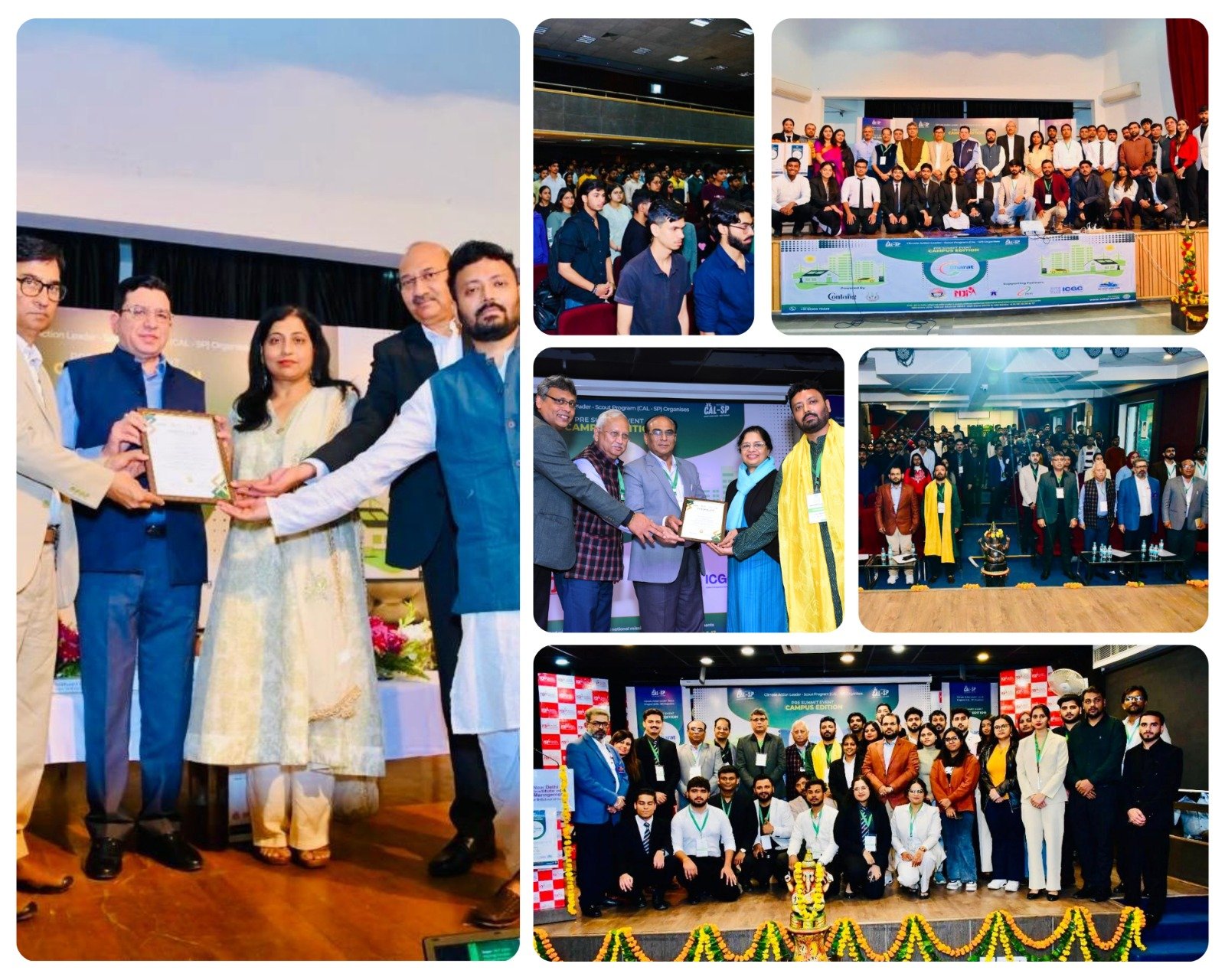
At a time when climate change is increasingly defining the trajectory of nations, India appears to be quietly shaping a response that is both structural and civilisational. The Pre-Summit Campus Editions of the Bharat Climate Summit 2026, organised by the Climate Action Leader – Scout Program (CAL–SP), signal the emergence of a new approach—one that seeks to embed climate leadership not merely in policy circles, but in the very foundations of society: its classrooms, campuses, and youth.
The first of these engagements, held on 18th February 2026 at the New Delhi Institute of Management (NDIM), set the tone for what can only be described as an institutional awakening. Bringing together voices from governance, ecology, diplomacy, and enterprise, the NDIM edition reflected a serious attempt to move beyond fragmented climate conversations toward a more integrated and actionable framework. Discussions led by Dr. R.K. Bharti Director, MSME-DFO, Ministry of MSME, Dr. S.D. Singh (IFS, Retd.) – Former PCCF, Uttarakhand, Ms. Archana Chatterjee – Program Manager, IUCN India, Dr. Samyak Monut – Vice President, IYNS Research Foundation, and Dr. Ashutosh Verma – Founder, Exalta India &Moseta, collectively underscored a critical reality—that India’s climate transition must be driven simultaneously by policy, industry, and knowledge systems.
This momentum carried forward into the Campus Edition at Maharaja Surajmal Institute of Technology (MSIT) and MIS on 26th February 2026, where the discourse expanded from institutional frameworks to youth-led engagement. The inaugural address by Air Marshal P.K. Roy – Former Commander-in-Chief of CINCAN PVSM, AVSM, VM, VSM, brought a strategic lens, linking environmental sustainability with national security. Contributions from Shri Vidya Bhushan Kumar (IFS, Retd.) – Special Monitor (NHRC) for Environment, Climate Change & Human Rights,Shri Subhash Chandra (IFS, Retd.) – Ex-CEO, CAMPA, MoEF&CC, Shri Keerthi Lal – Founder – Earth Twin, Shri Ankit Rawat – Founder & CEO, AGAATE, and Shri Anubhav Somara – Founder, BIRDVUE Aerospace, demonstrated how climate leadership today is inherently interdisciplinary—spanning governance, innovation, entrepreneurship, and advanced technology.
What distinguishes these engagements is not merely their scale, but their alignment with India’s broader national vision. The discussions resonate deeply with Mission LiFE, which calls for lifestyle-led environmental responsibility; the National Education Policy, which emphasises experiential and multidisciplinary learning; the vision of Viksit Bharat 2047, which seeks sustainable and inclusive growth; and India’s long-term commitment to Net Zero by 2070. At the same time, the themes align closely with key Sustainable Development Goals—SDG 11, 12, 13, 14, 15, 16, and 17, reflecting a comprehensive understanding of sustainability that bridges environment, governance, and society.
A particularly evocative element across both events was the showcase of the Special Screening: “The Last Drop” Award-winning short filmhighlighting the urgency of water security and Himalayan sustainabilityby The Great Himalayan Film Festivals. This intervention served as a reminder that climate change in India is not an abstract policy concern but a lived ecological reality—especially in fragile regions such as the Himalayas. By integrating storytelling into policy discourse, the initiative succeeded in connecting intellectual engagement with emotional urgency.
The growing strength of this movement is also reflected in the coalition supporting it. Organisations such as Conlang International, Farmer Organisation, New Delhi Institute of Management (NDIM), Indian Companies Growth Club (ICGC), Physical Education Foundation of India (PEFI), Indian Youth Nuclear Society (IYNS) Research Foundation, The Great Himalayan Water Festival, Green Stars, LIVNSENSE – GreenOps, and Samarth Society have come together to reinforce a shared vision. Their participation underscores an important shift—from isolated efforts to collaborative climate governance. A special acknowledgement of Shri Mayank Midha, Founder & CEO of GARV Toilets, whose support to these Pre-Summit Campus Editions reflects a deeper commitment beyond infrastructure. His contribution stands as a message that sustainability begins at the grassroots—through dignity, sanitation, and responsible civic behaviour.
Shri Kunal Prakash, Mission Head, has articulated a clear and compelling direction—that India must move beyond producing climate-aware individuals to nurturing climate-competent leaders who can govern, innovate, and transform systems. AndShri Sanjeev Choudhary, Co-Head of the mission, has emphasised the importance of building seamless bridges between education, industry, and governance, ensuring that young talent is not only informed but meaningfully integrated into real-world ecosystems. Together, their leadership reflects an ambition that is both bold and necessary.
It is within this context that the role of the Climate Action Leader – Scout Program (CAL–SP) assumes central importance. Conceived as India’s Climate Leadership Discovery Platform, CAL–SP is focused on preparing climate-competent leadership capacity at scale for India’s long-term climate future. Its vision is both expansive and precise—to convert India’s 25 crore students into climate-competent leaders who will shape policy, drive innovation, and build the country’s Net Zero future by 2070. In doing so, CAL–SP is not merely running programmes or events; it is attempting to create a national pipeline of climate leadership, aligned with India’s developmental and environmental aspirations.
Seen in totality, the Pre-Summit Campus Editions of the Bharat Climate Summit 2026 represent far more than preparatory engagements. They are the early contours of a national movement—one that seeks to transition India from awareness to action, from fragmentation to integration, and from passive concern to active leadership. As the country moves toward the full-scale summit in 2026, the significance of these early steps becomes increasingly evident.
For climate change, in the Indian context, will not be addressed by policy alone. It will be addressed by people—by a generation that is informed, empowered, and prepared to lead. And in the classrooms and campuses where this journey has begun, one can already discern the outlines of a future where climate leadership is not an exception, but a norm—deeply embedded in the idea of a Viksit, resilient, and sustainable Bharat.