Why Sales Forecasts Keep Missing Targets (And What Leaders Are Actually Missing)
Enterprise sales organizations are not short on tools.
They invest heavily in CRM systems, forecasting models, sales training, and performance dashboards. Pipeline reviews are structured. Deal stages are clearly defined. Managers track activity with precision.
And yet—quarter after quarter—forecasts still miss.
Deals that looked “committed” slip.
Win rates fluctuate unpredictably.
Revenue visibility remains fragile.
This isn’t a tooling problem.
It’s a misunderstanding of where forecasting actually breaks.
The Assumption Most Leaders Make
When forecasts miss, the default diagnosis is familiar:
- Pipeline quality needs improvement
- Deal inspection needs to be tighter
- Sales reps need better training
- Forecasting discipline needs reinforcement
All of these are valid. None of them are sufficient.
Because they all focus on what happens after opportunities exist.
But by the time a deal shows up in the pipeline, something far more important has already happened.
The Blind Spot No One Measures
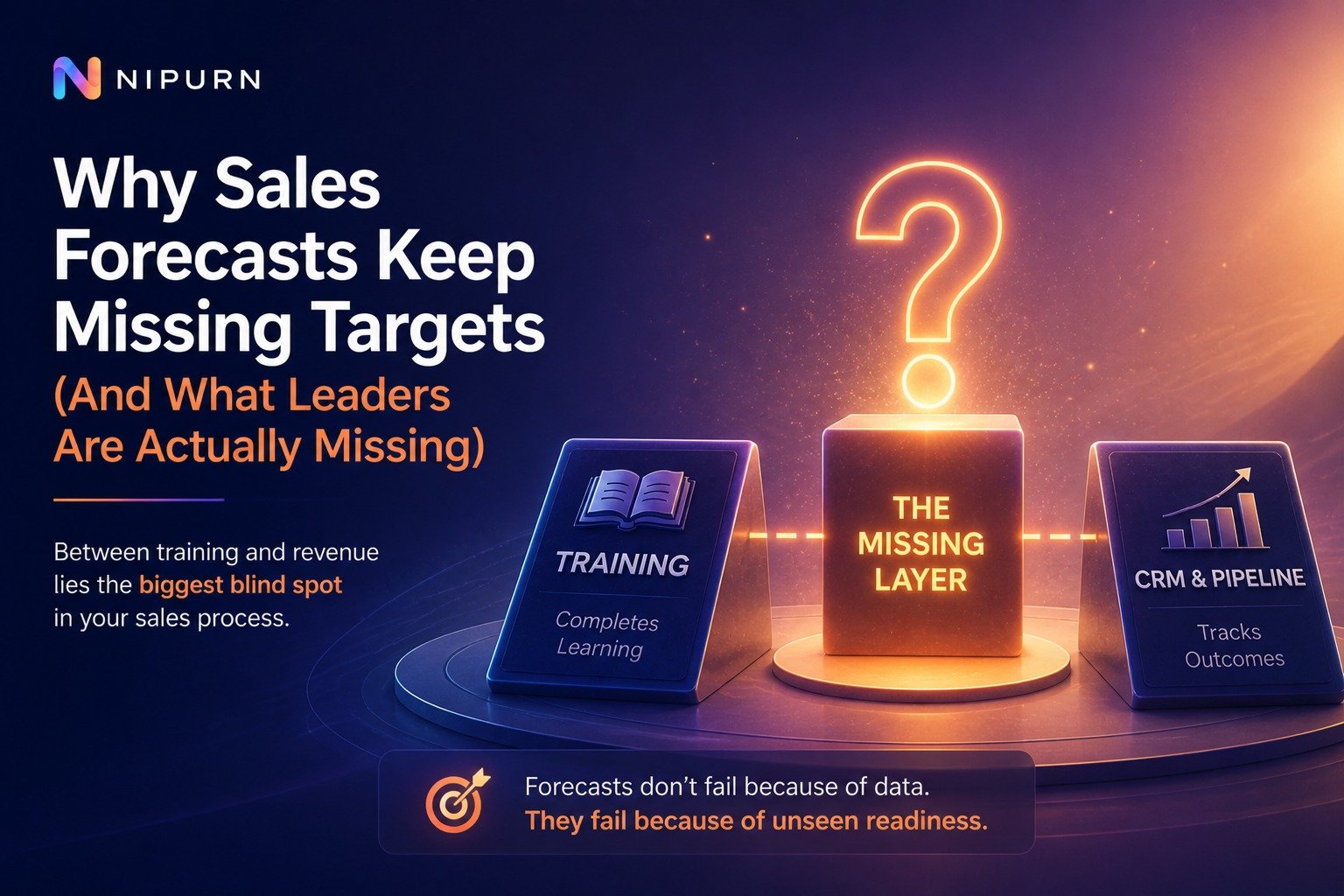
Between:
- A training session
- A manager’s feedback
- And the next real customer conversation
There is a critical gap.
A gap where no system exists to answer a simple but fundamental question:
Has the sales rep actually become better prepared for the next interaction?
CRM systems don’t answer this.
Training platforms don’t validate it.
Call analytics tools only evaluate what has already happened.
In other words:
Most sales organizations measure activity and outcomes.
But they don’t measure readiness in between.
Why This Gap Breaks Forecasting
Forecasting assumes that pipeline reflects reality.
But pipeline is built on conversations.
And conversations are shaped by execution.
If execution is inconsistent, then pipeline data becomes unstable.
A deal may look strong in CRM, but:
- Objections may not be handled effectively
- Value articulation may be weak
- Buyer confidence may not actually exist
These are not pipeline issues.
They are readiness issues that occurred before the deal even progressed.
By the time leaders review pipeline data, the signal is already distorted.
The Scaling Problem Most Teams Don’t See
At smaller scales, this gap can be managed through manager intuition.
At enterprise scale, it becomes systemic risk.
- With 20 reps, leaders can stay close to execution
- With 100 reps, visibility becomes fragmented
- With 500+ reps, inconsistency compounds silently
Coaching becomes uneven.
Standards drift.
Performance varies not because of effort—but because of lack of structured visibility.
What looks like a forecasting problem is often a distributed execution problem.
A Shift in How Sales Performance Is Measured
To improve forecast accuracy, organizations don’t just need better pipeline discipline.
They need a new layer of measurement.
One that focuses on what happens before pipeline outcomes are formed.
This is where a new category is emerging:
Sales Readiness Infrastructure
A system designed to:
- Measure how prepared reps are before customer interactions
- Detect instability in execution patterns
- Identify performance risks early—before they impact deals
- Provide structured visibility across individuals and teams
This is not about replacing CRM or training.
It’s about filling the gap between them.
Rethinking Predictability
For years, sales organizations have relied on two primary signals:
- Training completion as a proxy for capability
- Pipeline data as a proxy for outcomes
But neither directly answers:
Are our reps consistently ready to perform at the level required for the next customer interaction?
Until that question is measurable, forecast accuracy will remain inconsistent—no matter how advanced the tools become.
Because predictability doesn’t start in dashboards.
It starts in execution.
Where This Leaves Enterprise Leaders
The next evolution of sales organizations will not be defined by more tools, more dashboards, or more training programs.
It will be defined by visibility into readiness before revenue is at risk.
Leaders who build this visibility will move from reactive forecasting to proactive control.
Those who don’t will continue to manage outcomes after they’ve already been influenced.
A Final Though
Forecasting doesn’t fail because leaders lack data.
It fails because the most important signal is missing.
Not pipeline.
Not activity.
Not outcomes.
But readiness.
And until readiness is visible, predictability will always be fragile.
About Nipurn
Nipurn is built around this exact problem—enabling enterprise teams to measure and understand sales readiness before outcomes occur. By focusing on execution signals and early risk detection, it helps organizations bring structure and visibility to the most overlooked layer of sales performance.
https://nipurn.com/