Search Is Changing: Why Businesses Need to Think Beyond SEO
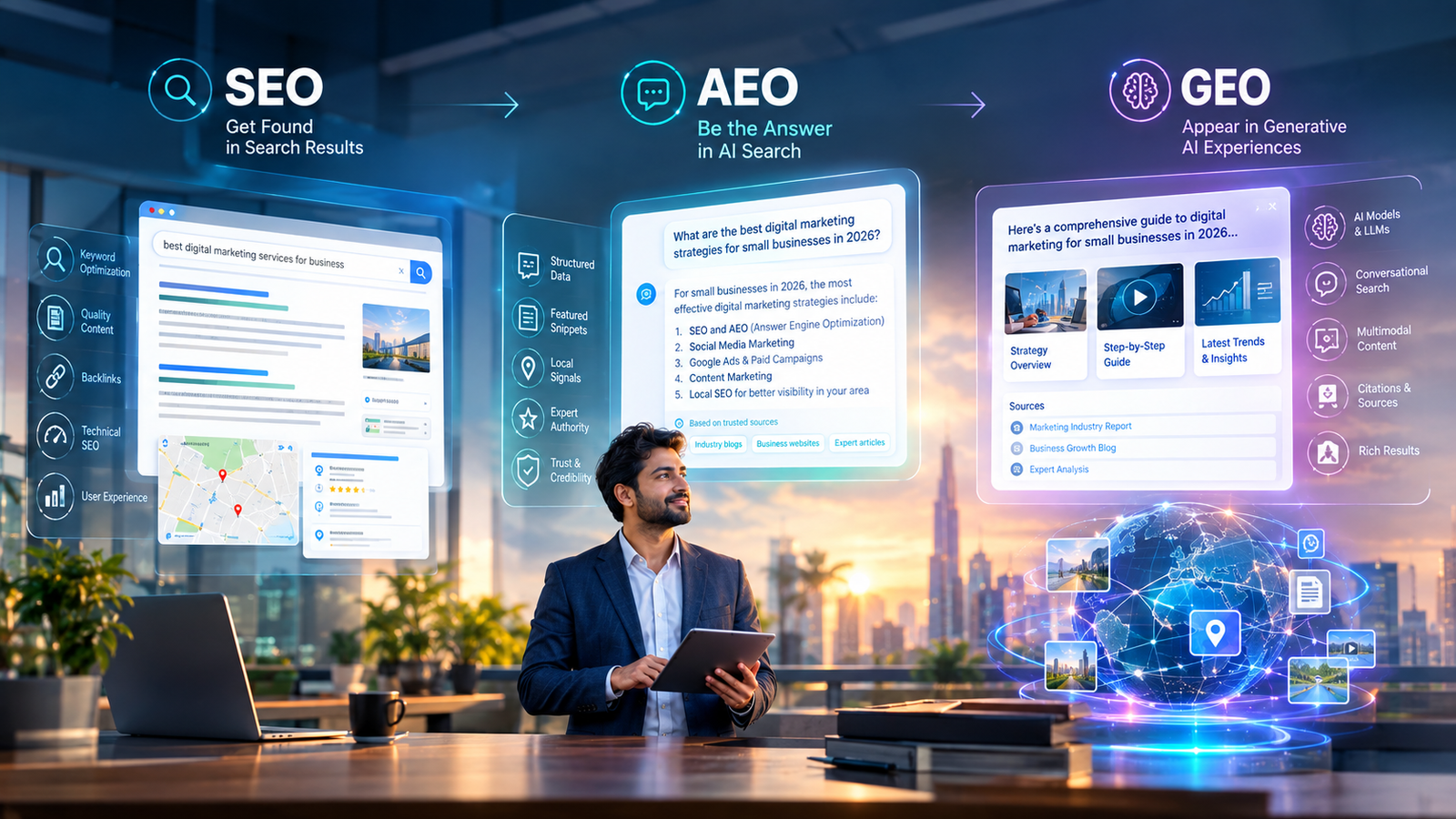
For years, digital visibility was closely associated with one question: “Where does my website rank on Google?” That question still matters, but it no longer describes the entire search journey.
People increasingly ask complete questions rather than entering short keyword combinations. Search experiences are also becoming more conversational, visual and AI-assisted. Google now provides generative AI experiences within Search, while ChatGPT can search the web and provide answers with links to sources. This means businesses need to think not only about ranking pages, but also about whether their information can be understood, trusted and referenced by answer engines and generative AI systems.
This is where SEO, AEO and GEO begin to work together.
SEO: Building the Foundation
Search Engine Optimization remains the technical and content foundation. A website needs crawlable pages, useful content, clear internal linking, strong technical performance, relevant entities and credible references.
Structured data can also help search engines understand what a page represents. Google’s documentation notes that structured data provides standardized information that helps Google understand page content and can support enhanced search appearances.
However, traditional keyword targeting alone is increasingly insufficient. A page should answer the underlying intent behind a query, not simply repeat a phrase multiple times.
AEO: Optimizing for Answers
Answer Engine Optimization (AEO) focuses on making information easy for answer systems to understand and use.
Consider a query such as “What is the best solar system for a small business?” A conventional search may return a list of pages. An answer engine may instead synthesize information from multiple sources and present a direct explanation.
To become useful in that environment, content should provide clear definitions, direct answers, supporting evidence, comparisons, examples and logically organized information. Questions should be answered naturally, while important facts should be easy for both people and machines to identify.
AEO therefore shifts the content mindset from “How do I rank for this keyword?” toward “How can I provide the clearest answer to this problem?”
GEO: Preparing for Generative Search
Generative Engine Optimization (GEO) extends this thinking to AI-generated search experiences. The objective is not simply to create content for a search engine, but to build a body of information that AI systems can interpret as relevant, reliable and contextually useful.
That requires more than publishing large volumes of AI-generated articles. Businesses need original insights, first-hand expertise, consistent business information, strong topical coverage, trustworthy authorship and technically accessible websites.
Google’s recent guidance on generative AI search emphasizes that established SEO fundamentals remain relevant, while useful, non-commodity content and strong coverage across formats—including local, image and video content—can matter in generative experiences.
The Three Should Work Together
SEO, AEO and GEO should not be treated as three separate marketing packages. They are better understood as layers of the same visibility strategy.
SEO helps search engines discover and understand a business. AEO structures knowledge so systems can answer questions accurately. GEO expands that approach into generative and conversational discovery.
For businesses, this creates a new strategic question: if a potential customer asks Google, ChatGPT or another AI system about your industry, product or service, what information will those systems find—and which sources will they trust?
The answer begins with building a website that is technically accessible, genuinely useful, clearly structured and supported by real expertise.
YSEO Solutions is increasingly focusing its digital strategy around this broader search environment, combining SEO foundations with Answer Engine Optimization and Generative Engine Optimization. The goal is not simply to chase the next algorithm update, but to prepare businesses for a search ecosystem where being visible may increasingly mean being understood, selected and referenced by both search engines and AI systems.