The Panchkula School Incident: A Wake-Up Call for Every Parent
By Chiranjiv Jain, Certified Parenting Coach
A recent incident at a school in Panchkula has shaken parents across the country. An eight-year-old boy is alleged to have violently attacked a six-year-old girl. It is easy to treat this as one sad piece of news and move on. I believe it is a warning for every family, every school and every person who is raising a child.
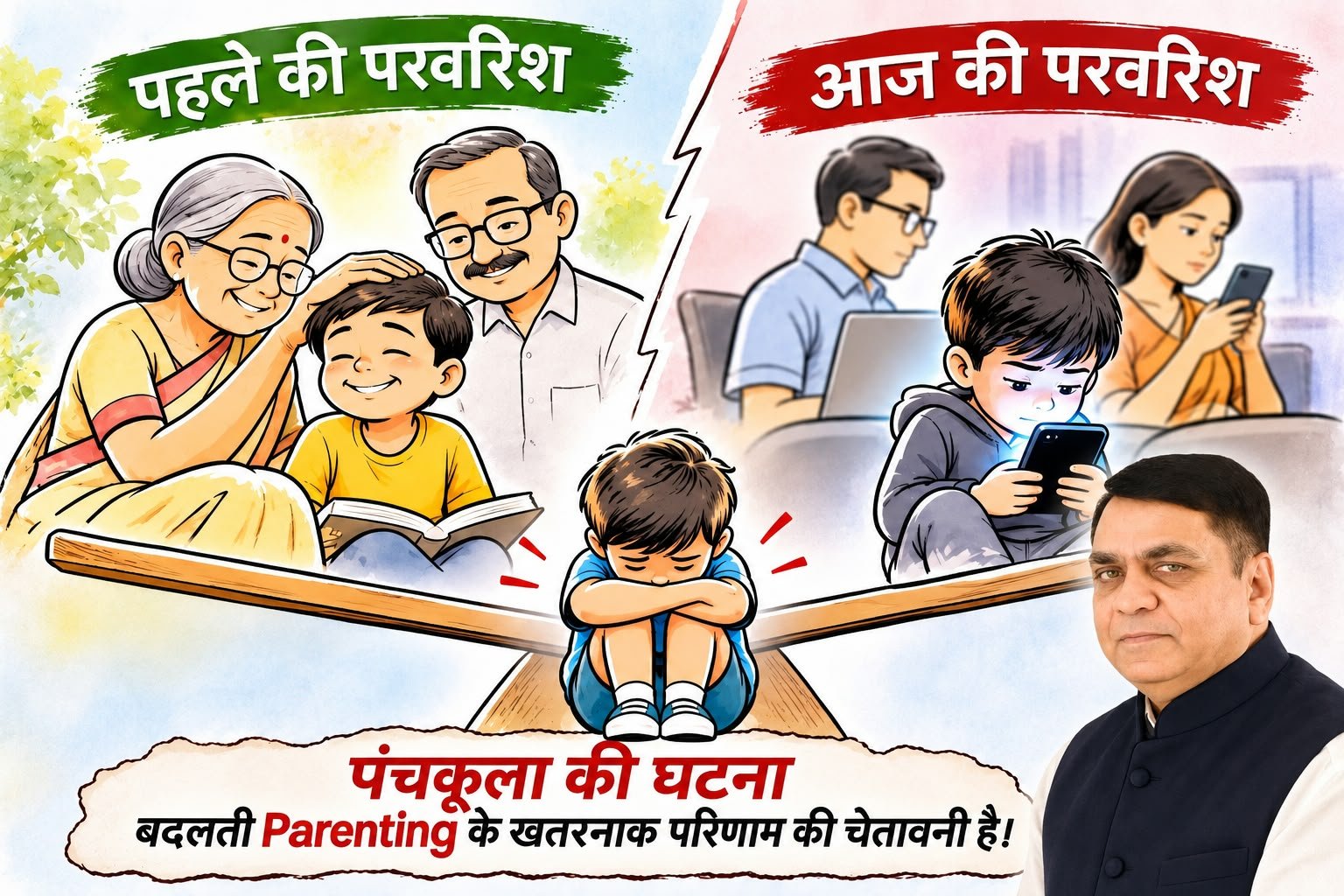
The biggest question is not why the child did it. The real question is how such violence took shape in a mind so young. Eight is the age when a child is still learning values, empathy, the difference between right and wrong, and how to live with others. To answer that question, we have to look at parenting in three parts: what yesterday gave us, what today is asking of us, and what tomorrow will expect from us.
Yesterday’s parenting had less money and fewer comforts, but it had time. Children grew up with parents, grandparents and elders who talked to them, corrected them and listened to them. Values were not taught as a subject. They were seen every day in how the adults at home behaved. That is the wisdom we have inherited. A child needs presence more than presents, and a child learns more from our conduct than from our advice.
Today’s parents work hard for their children. They give them good schools, modern gadgets and every facility they can afford. Yet in this race, the quality time spent with the child keeps shrinking. A child now has a smartphone, the internet and many kinds of entertainment. But does that child have one person to whom he can say everything in his heart, without fear or hesitation?
We worry about studies, exams and careers. We pay far less attention to the anger, loneliness, jealousy, insecurity and emotional stress growing inside our children. Getting good marks for a child is not the whole of good parenting. Making that child a good human being is just as important.
The digital world has made this harder. Mobile phones reach children very early, and much of what is available online does not suit their age or maturity. Not every child who watches violent videos or games becomes violent. But when a child sees violence again and again and accepts it as entertainment, sensitivity can reduce. Parents should not only count screen hours. They should know what the child is watching, who the child is talking to, and how it is affecting behaviour.
Children often cannot put their pain into words. Their behaviour speaks for them. Sudden extreme anger, hurting other children, cruelty to animals, frightening others, violent reactions to small things or staying alone all the time are signs that need attention. Every act of mischief is not a disorder. But repeated aggression should not be brushed aside as normal either. Before we scold or punish, we must understand the feeling or problem behind the behaviour.
Tomorrow’s responsibilities begin at home. Parents should spend some time with their children every day, without a mobile phone and without any other distraction. Ask about their friends, their school and their feelings. Teach them that hurting someone is wrong and that feelings should be expressed through conversation, not violence. If every problem at home is solved by shouting, insulting or hitting, no lecture will teach a child to be gentle.
Schools share this duty. They are not only centres of bookish knowledge. They need trained counsellors, emotional education, alert supervision of young children, effective safety and complaint systems, and regular dialogue between teachers and parents.
We train teachers to teach. We should also help parents to parent. Every school should hold regular parenting workshops on child psychology, digital discipline, emotional intelligence and positive discipline. Parenting is not a skill we are born with. It is a process of constant learning.
This is not a time for blame. It is a time for honest reflection. An eight-year-old is also a child in development, and his behaviour must be examined with sensitivity, fairness and expert help. The pain of a little girl must not be forgotten as yesterday’s headline.
We are preparing our children for their future. Are we also preparing them to be better human beings?
About the author: Chiranjiv Jain is an educationist and Certified Parenting Coach who has worked with students, parents and teachers across Chhattisgarh since 1993. He has guided thousands of students through competitive examinations and served as parenting coach on IBC-24’s programme “Main Tere Dil Ka Tukda”.