From a College Dorm in 2000 to 100,000 Businesses Worldwide: The 26-Year Bet Behind Dinesh Agarwal’s RecurPost
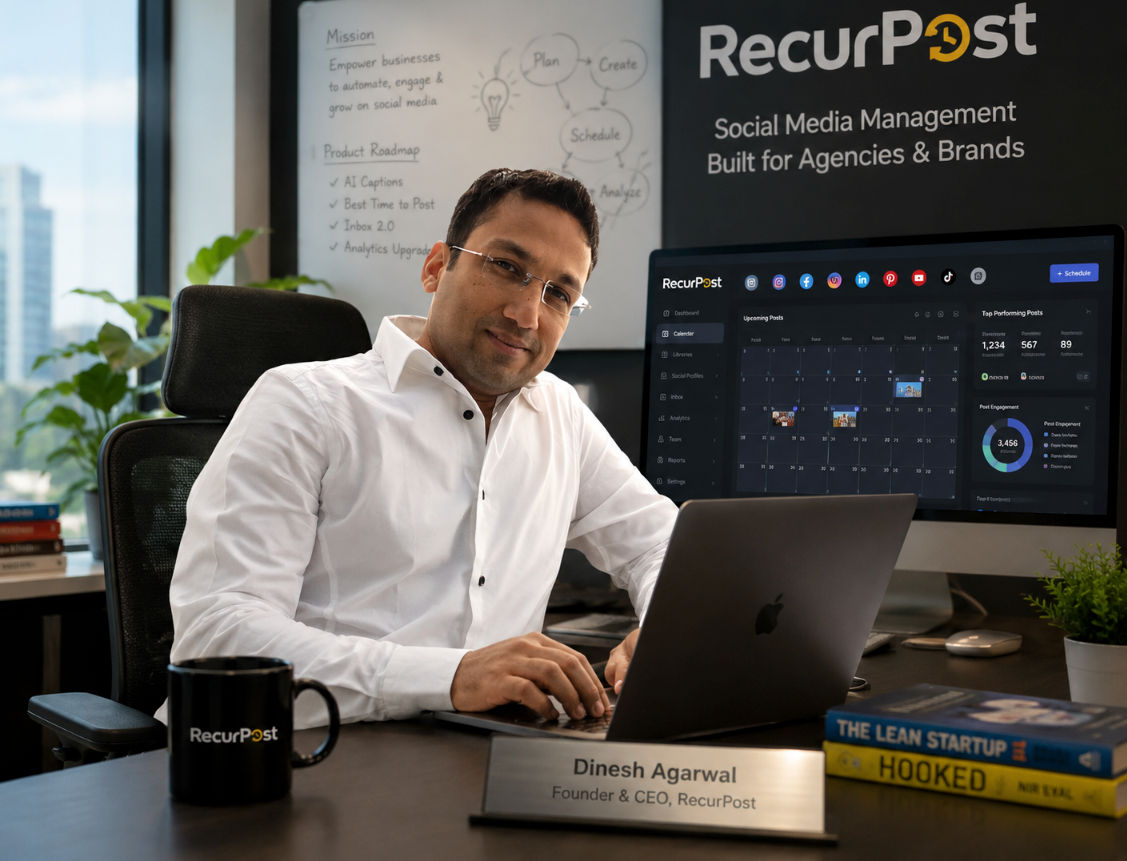
In 2000, while he was still a college student, Dinesh Agarwal started a software company called MuTech Solutions. It was a consultancy, building software for local businesses.
It is worth pausing on what that meant at the time. India was connecting to the internet over dial-up lines that charged by the minute. There was no cloud, no SaaS, no app stores, and no funding ecosystem waiting to write a cheque to a student with an idea. Starting a software company from a college campus was not a career path. It was closer to an act of stubbornness.
Twenty-six years later, that stubbornness has compounded into RecurPost, a social media management platform used by more than 100,000 businesses across the globe. Marketing agencies in the United States, salons in Australia, consultants in the UK, and multi-location brands across Asia log in every day to plan, publish, and manage their social media. More than 2 million posts have gone out through the platform. All of it is run from India, competing head-on with heavily funded American giants like Hootsuite and Buffer.
RecurPost has never taken outside investment. It is bootstrapped, and it is profitable. In a category where the best-known names raised hundreds of millions of dollars to buy their growth, that single fact is the most interesting thing about the company.
The distance between those two companies is the whole story. MuTech served businesses Agarwal could drive to. RecurPost serves businesses he will never meet, in countries he has never worked in. The skill that carried him from one to the other was not technical. It was learning to hear what a customer means when they cannot quite say it.
The long game nobody talks about
The startup press celebrates the eighteen-month rocket ship. Agarwal’s career looks nothing like that. Sixteen years separate MuTech Solutions in 2000 from the launch of RecurPost in 2016. Another decade has passed since.
Those years were not idle, and MuTech did not fail. It ended because Agarwal moved cities to continue his education. He took a master’s degree at DA-IICT in Gandhinagar, a specialist information and communication technology institute, and then moved to the United States for a PhD at Georgia State University in Atlanta, spending a substantial stretch of his twenties and thirties in formal research before returning to building products for customers.
It is an unusual route into SaaS. Most founders arrive from engineering or from sales. Agarwal arrived from research, and the training shows in how RecurPost is run: form a hypothesis, gather evidence, and resist the urge to ship on instinct alone.
Ask him about those years and he does not describe them as a detour.
“Everything I got wrong before 2016 is the reason RecurPost works. You cannot shortcut that. You can read every book on building software and still not know what a customer means when they say the tool is confusing. That understanding takes years of being wrong in public.”
It is a deeply unfashionable message in an industry that sells speed. It is also, for the thousands of Indian entrepreneurs who did not get funded in their first year and are quietly wondering whether to keep going, probably the most useful thing anyone can tell them.
The problem nobody wanted to solve properly
By 2016, social media scheduling looked like a solved problem. Dozens of tools existed. But talk to the people who actually run social media for a living, agency owners juggling fifteen clients, small business owners posting between customer calls, and a different picture emerges. Tools that charge per user until the bill triples. Clients who have to hand over their passwords just to get their accounts connected. Posts that silently fail at 2 a.m. with no explanation.
These are the unglamorous details Agarwal built his second act around.
RecurPost lets an agency onboard a client’s social accounts through a simple invite link. The client approves access on the platform’s own permission screen and never has to share a password or learn a new dashboard. Pricing is based on the number of social profiles rather than team seats, so an agency can bring its whole team in without watching the invoice climb. And when a post fails, the platform explains why in plain language, with a retry button sitting right next to it.
None of this makes for a flashy keynote. All of it makes for customers who stay.
A founder who still takes sales calls
What sets Agarwal apart from most SaaS founders at his stage is how close he stays to the ground. Twenty-six years in, he still runs a hands-on sales team, still reviews customer demo recordings personally, and still treats every conversation as product research. Feature decisions at RecurPost routinely trace back to something a customer said on a call the previous week.
“The moment a founder stops listening to sales calls, the product starts drifting away from reality. Our roadmap is not written in a strategy meeting. It is written by agency owners telling us what wastes their time.”
That philosophy shows up in the depth of the product. RecurPost supports scheduling across Facebook, Instagram, X, LinkedIn, Pinterest, TikTok, YouTube, Google Business Profile, Threads, and Bluesky, and it lets a user tailor a single post differently for each network, down to separate captions, images, and publishing times per platform. It is the kind of granular control that power users beg for and most tools never build, because building it requires actually understanding how the work gets done.
The larger message for Indian entrepreneurs
Agarwal has become a quiet example for a generation of Indian founders who want to build global software businesses without leaving home. His argument is simple: the advantages that once belonged only to Silicon Valley, access to customers, distribution, and talent, are now available to anyone willing to put in the time.
“Indian founders often aim at the Indian market first because it feels reachable. I would tell them the opposite. The world is reachable. A customer in Texas does not care where your office is. They care whether your product respects their time.”
He is equally direct about the timeline.
“I started MuTech in college in 2000. RecurPost did not launch until 2016. If someone had told me back then that the useful part was still that far ahead, I would not have believed them. But that is how it works. You are not late. You are early in a longer game than you think.”
He can afford to say it because he has the receipts. RecurPost was built without a rupee of outside capital and it makes money. For Agarwal that is a practical position rather than a moral one. A profitable company answers to its customers, because they are the only people funding it.
In an industry obsessed with noise, Dinesh Agarwal has built something rarer: a company that grew because it was useful, on its own revenue, over a span of years most founders never give themselves. For the small businesses and agencies who run their social media through RecurPost, that usefulness shows up every single day, one scheduled post at a time.
RecurPost is a social media management platform serving over 100,000 businesses worldwide. Learn more at recurpost.com.