From Months of Paperwork to Weeks of Readiness: How Cybroscape’s GxP Copilot Is Rewiring GxP Validation for Life Sciences
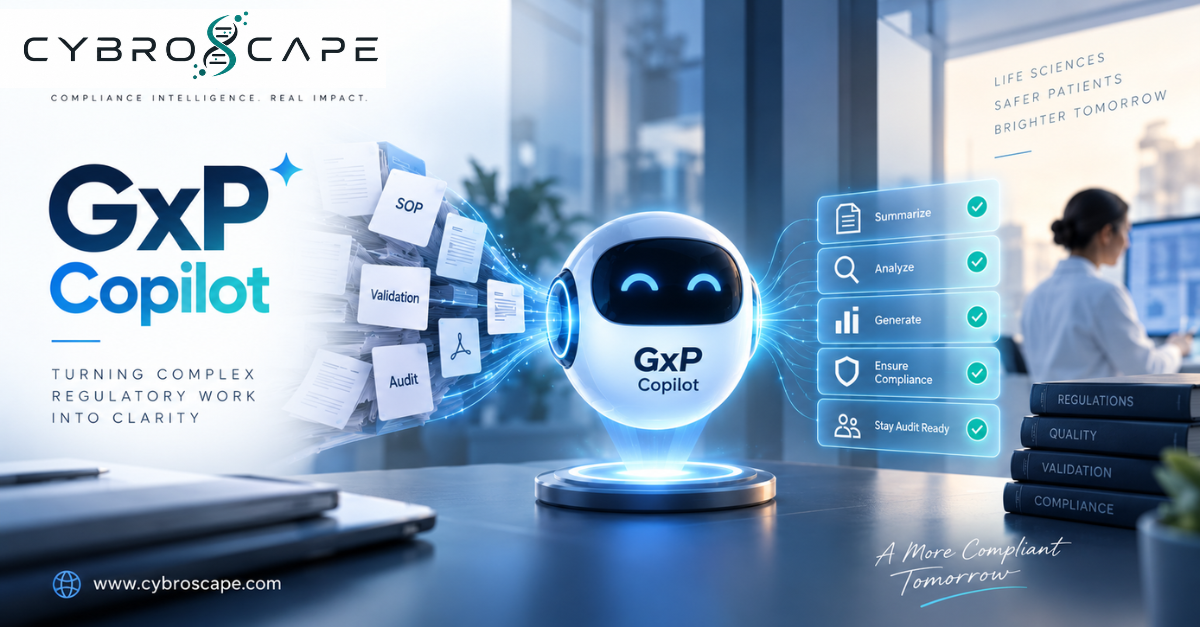
Ask anyone who runs validation at a pharma or biotech company what eats their year, and you will hear the same answer before you finish the question: the paperwork. Not the science, not the software — the proof. The requirement interpretation, the risk assessments, the test scripts, the traceability matrix that goes stale the moment it is exported, the evidence you assemble twice because the first version aged out. This is GxP validation, and for most teams it is still done the slow way, one blank page at a time.
Cybroscape Technologies started with a blunt observation about that reality: proving a system is compliant now takes longer than building the system did. Its answer is GxP Copilot, an AI-native validation platform — and the reason it is worth paying attention to is not that it writes documents. Plenty of tools write documents. It is what the platform refuses to let the AI do.
The Turning Point That Changed Everything
For a long time, computer system validation was built for software that barely changed. You validated a system once, and it sat there. That world is gone. Cloud platforms ship updates on the vendor’s schedule. SaaS gets adopted in weeks. And now AI itself is turning up inside GMP environments, which raises a question the industry genuinely has not settled: if an AI touches a regulated record, who validates the AI?
Two things moved at once. The FDA leaned into Computer Software Assurance (CSA) — a real shift away from testing everything the same way, toward putting the effort where the risk actually is. And regulators started asking harder questions about AI in regulated work. Most software companies reacted by bolting a chatbot onto an existing tool and calling it innovation.
Cybroscape read it differently. The problem was never that people didn’t work hard enough. It was that the tools handed them a blank page every time and then made them defend every line of it by hand. So the team built its GxP Copilot platform to run the GAMP 5 lifecycle end to end: classify the system, scope the deliverables, draft them under strict rules about where each claim comes from, and lock every step behind 21 CFR Part 11 signatures and a tamper-evident audit trail. The honest headline result is a validation program that used to take a squad a quarter now moving in weeks — because the machine does the drafting and the assembly, and the experts do the judging and the signing.
What Is GxP Copilot?
The idea underneath it is simple. In a regulated business, an AI answer is only worth something if you can defend where it came from. That belief shows up in three ways.
First, the AI does not get to make the calls that matter. It never decides the GAMP category, the GxP impact, or the risk level — a deterministic engine does that, by rule, with its reasoning shown. This is the line responsible GxP AIhas to hold: the model can inform the decision, but a machine that adapts and improvises should not be the one classifying a system that affects patient safety.
Second, it has to show its work. Every determination the AI proposes has to quote the source document, and the platform checks that the quote is actually there before it trusts it. If it can’t ground a claim, it doesn’t dress it up as fact — it flags it and hands it to a human. It cites regulations at the document level and won’t invent a clause number to sound precise. That is the whole difference between a chatbot and Regulatory Compliance AI you would put in front of an inspector.
Third, a person signs, not the software. No AI draft becomes an approved record on its own. It goes through author review, QA approval, and a 21 CFR Part 11 electronic signature, all recorded in an append-only, hash-chained trail, with segregation of duties enforced so nobody approves their own work. The AI proposes. People decide. The evidence stays put.
Put those together and you get the thing that has been missing: GxP software that is genuinely fast and still holds up when someone asks it a hard question. A live traceability matrix flags coverage gaps before an auditor finds them. A CSA-native approach sizes the testing to the actual risk instead of testing a login screen as if lives depended on it.
A Name That Commands Respect
Cybroscape is not a one-product company banking on a demo. Alongside its flagship Validation AI, it runs TraceDraft, a clinical documentation tool where every generated sentence links back to the data that produced it. Same conviction, different problem.
What actually sets the company apart is what it won’t do. It won’t ship AI as a black box. It won’t let a marketing claim run ahead of what the product can prove — which, in an industry that lives and dies on trust, is rarer than it should be. And it has built toward the emerging EU Annex 22 expectations for AI in GMP from the start, rather than leaving customers to invent that posture themselves. Deterministic where it has to be, grounded everywhere, human-signed always.
The Message That Is Resonating Across Life Sciences
“Teams aren’t slow because they’re careless,” is how the Cybroscape team puts it. “They’re slow because the tooling makes them start from nothing and then prove every page by hand. Hand them a package that’s already ninety percent there and grounded in their own source, and the whole job changes shape.”
The people leaning in are the ones who feel the pain most directly — validation leads, QA directors, CSV and regulatory specialists at both scrappy biotechs and established pharma. They are running pilots on their own systems and their own URS documents, watching validation cycles fall from months to weeks without adding headcount, and without giving an inch on their Part 11 or Annex 11 position.
The pitch, when you strip it down, is unglamorous and exactly right: stop treating validation as a tax you pay before go-live. “When it’s grounded, traceable, and signed as you build it,” the team says, “you’re not scrambling the week before an audit. You already walked in ready.”
See how GxPCopilot works on your own system, URS, or validation scenario — explore the platform at cybroscape.com.