From Two Months to Two Weeks: How Ganesh Ghatti and Squirrel Technologies Are Using AI to Transform MVP Development
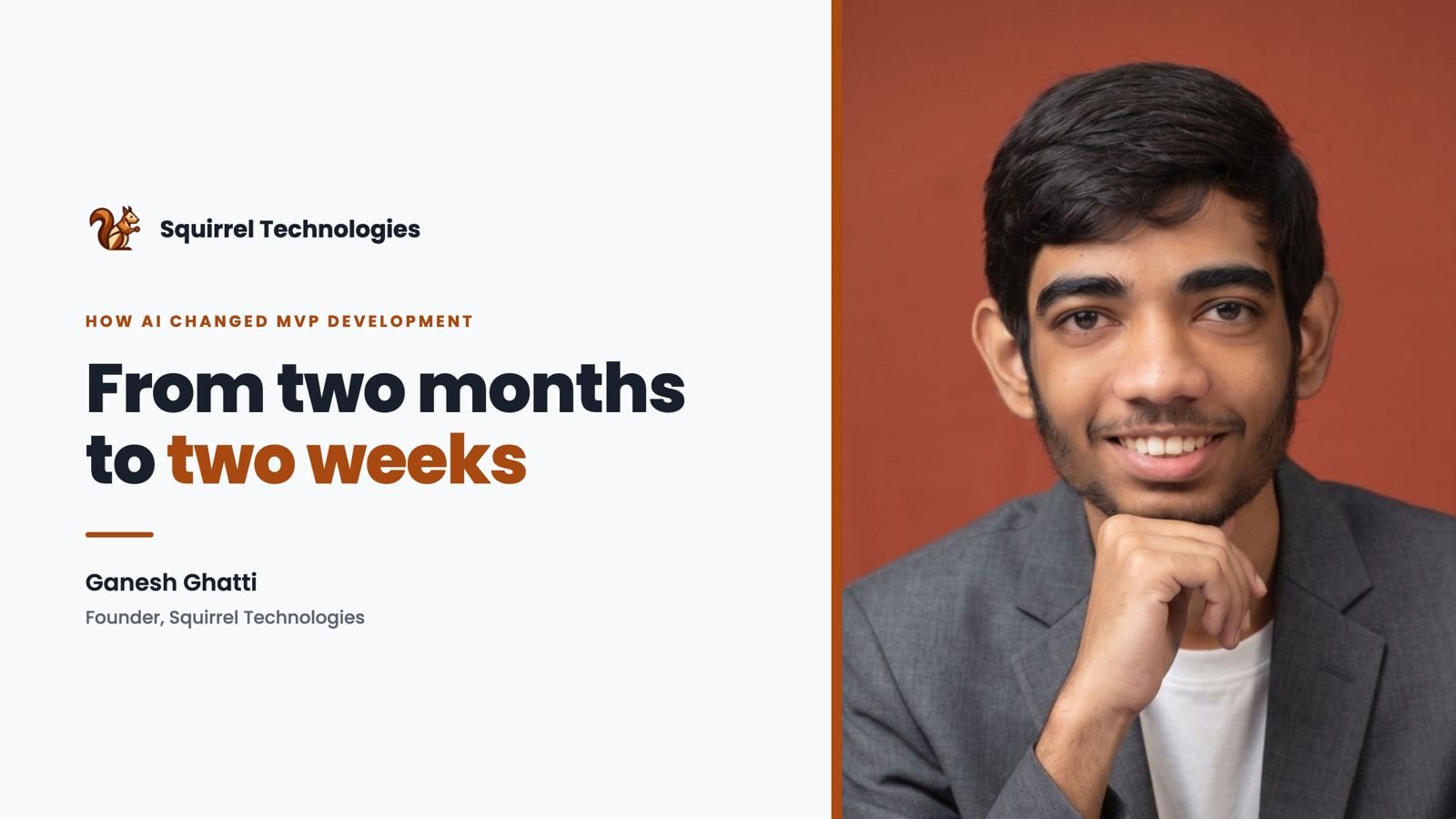
For years, building a Minimum Viable Product (MVP) was a time-consuming process. Founders with promising ideas often had to wait two months or longer, sometimes investing a significant portion of their savings, before their products reached real users.
Ganesh Ghatti, founder of Bengaluru-based Squirrel Technologies, has spent the past few years rethinking this traditional approach. Today, his team can build and launch many MVPs in approximately two weeks. According to Ganesh, the biggest factor behind this transformation is artificial intelligence (AI).
“Before AI coding tools, building an MVP for a software product, mobile application, or AI-based solution used to take at least two months, and sometimes even longer. AI has significantly changed how quickly much of this work can now be completed,” Ganesh explains.
How Traditional MVP Development Worked
Traditionally, software development involved developers manually writing every line of code. Once development was complete, the product moved into quality assurance (QA) testing, followed by deployment. Each stage depended on the completion of the previous one, adding considerable time to the overall process.
However, according to Ganesh, the biggest challenge was not simply the time required to write code. It was the tendency of founders to build too much.
“This is where many people get an MVP wrong. They try to build the entire product,” he explains.
An MVP is not intended to be a complete version of a product. Its primary purpose is to determine whether an idea solves a genuine customer problem. When founders attempt to include every possible feature from the beginning, they often spend months developing functionalities that customers may not even need.
How AI Has Changed the Development Process
At Squirrel Technologies, developers now use AI-powered coding tools such as Claude, Cursor, and Codex to accelerate development.
These tools allow a single developer to build the core functionality of a focused MVP in approximately one week. AI also assists with writing unit tests and identifying potential edge cases.
The team uses AI during the design process as well, transforming clients’ brand guidelines into product demonstrations that provide an early preview of the proposed application’s appearance and experience.
However, Ganesh emphasises that AI does not eliminate the need for human expertise and decision-making.
The responsibility for deciding what needs to be built remains with the team. Human testers review every user journey before launch, ensuring that the product works as intended.
Security is another area where the company does not compromise. Every development project includes appropriate authentication and rate-limiting mechanisms.
“This is particularly important when developing AI-powered products because every call to a language model’s API involves a cost. These expenses can become significant, so we ensure that the necessary security systems are properly implemented,” Ganesh says.
Before launching an AI product, the team also monitors token consumption and evaluates the cost associated with individual AI API calls.
Inside the 14-Day MVP Development Process
The ability to deliver an MVP within two weeks comes from a structured development process built around clear priorities and efficient execution.
Squirrel Technologies follows a 14-day framework for most of its projects.
Day 1 – Project Scope and Planning
The process begins with a discussion involving the client’s key decision-makers, ideally limited to two or three people, along with the company’s product manager or lead developer.
Together, they identify the essential features required to test the product idea. Any additional functionality that is not immediately necessary is excluded from the initial scope.
Days 2 and 3 – Design and User Experience
The team analyses two or three leading competitors, finalises the required pages and screens, and maps out the complete user journey.
A typical MVP includes three to five informational pages explaining the product and approximately five to ten screens within the application itself.
Days 4 to 9 – Development
During this phase, developers build the core functionality, including user sign-in, database integration, and other essential product features.
AI-powered coding tools help accelerate development while allowing the team to maintain its focus on the agreed project requirements.
Day 10 – Deployment
The product is deployed and made available for real users.
Ganesh believes that a simple MVP does not require an unnecessarily complicated technical infrastructure. Features such as microservices, queues, content delivery networks (CDNs), and other advanced systems may not be essential during the initial validation stage.
Days 11 to 14 – Testing and Launch
The final stage involves human testing of the complete user journey, followed by one or two rounds of improvements based on the findings.
Once the necessary checks and adjustments are complete, the product is launched.
Real-World Results: Putting the Approach into Practice
Squirrel Technologies has applied this development approach across projects in different industries.
One recent example involved an AI-powered lifestyle application designed for daily journaling. The client approached the company with the designs already prepared. The Squirrel Technologies team developed the iOS and Android applications and submitted them to both app stores.
The application received approval from the Apple App Store and Google Play on its first submission and went live just 14 days after the project began.
Another example is a crowdfunding platform designed to raise funds for medical emergencies, education, and disaster relief without charging any platform fees.
For this project, the team developed the MVP entirely from scratch. The initial product eventually evolved into a full-fledged platform that has successfully conducted more than 125 fundraising campaigns, receiving donations from over 10,000 donors.
Overall, Squirrel Technologies has launched more than 12 products, including six app-store launches, serving clients across more than five countries.
Understanding the Limitations of Two-Week Development
Although AI has significantly accelerated product development, Ganesh is realistic about the limitations of a two-week timeline.
Certain projects require additional time, particularly those involving external approvals, extensive research, or machine learning model training.
For example, applications that require approval from third-party platforms such as the Apple App Store may face delays beyond the development team’s control.
“Because the timeline depends on external parties, it is not advisable to guarantee a two-week launch in every situation,” Ganesh explains.
The lifestyle application’s first-attempt approval was supported by the team’s experience with app-store submissions. However, he makes it clear that such outcomes cannot be guaranteed for every project.
This practical approach reflects the company’s emphasis on realistic timelines rather than making promises that may not be achievable.
Advice for Founders Planning to Build an MVP
For entrepreneurs looking to develop their first MVP, Ganesh recommends asking potential development partners several important questions before signing an agreement.
Founders should understand which features are genuinely necessary to validate their idea and how removing unnecessary functionality could affect the overall project cost.
They should also clarify recurring expenses, including hosting charges and AI usage costs, which may continue even after the development agency’s fees have been paid.
Other important considerations include ownership of the source code, designs, and project accounts; the security measures implemented during development; and the level of technical support available after launch.
According to Ganesh, understanding these details early can help founders avoid unnecessary expenses and build products with a clearer direction.
“An MVP is not the full product. Its purpose is to test whether an idea solves a real customer problem. AI allows us to get that answer in weeks instead of months, changing what founders can afford to experiment with,” he says.
About Squirrel Technologies
Squirrel Technologies is a Bengaluru-based MVP development and AI product company founded by Ganesh Ghatti. The company specialises in building MVPs, AI-powered products, web and mobile applications, and business automations for startups and established businesses in India and international markets.
With a development approach that enables many MVPs to be built in approximately two weeks, the company focuses on helping businesses validate ideas, accelerate product development, and bring digital solutions to market efficiently.
Squirrel Technologies has launched more than 12 products, including six app-store launches, for clients across more than five countries.