PUBLIC RELATIONS FEATURE
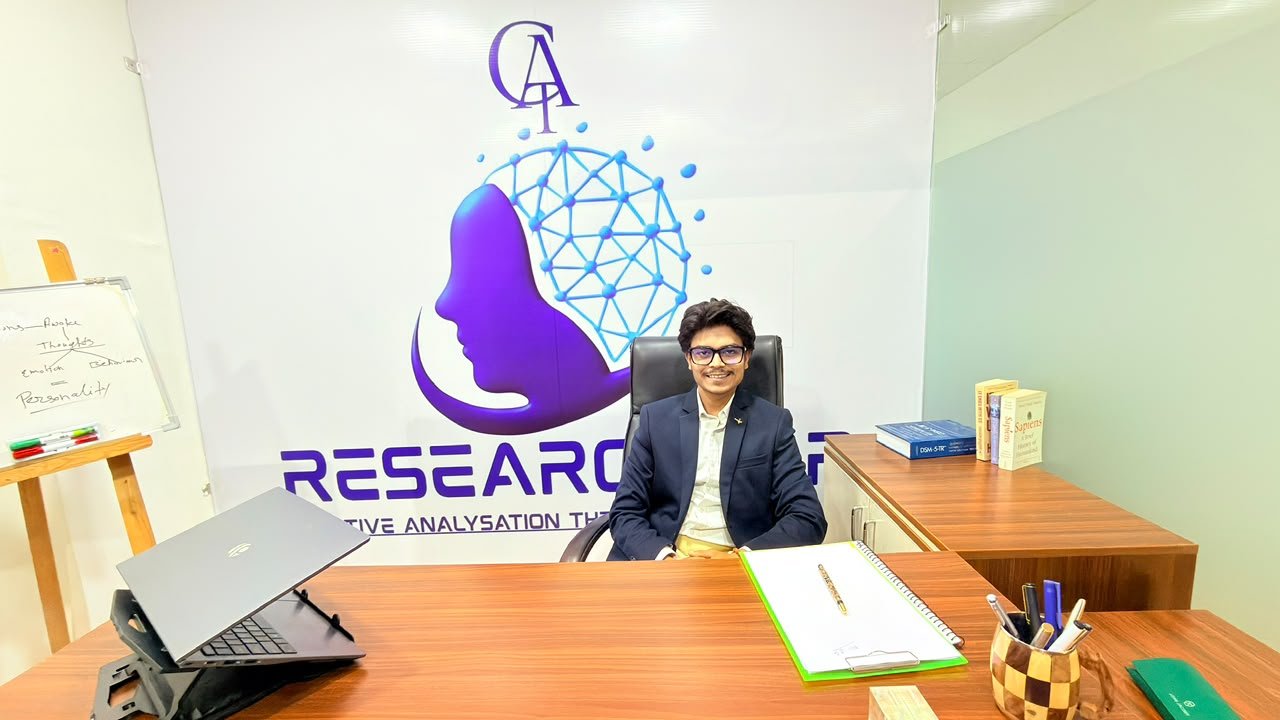
Mental Health in India Is No Longer a Private Conversation
How Sudhanshu Bharane and CAT Research LLP are working toward a culture where psychological well-being is understood, discussed and supported.
THE BIG IDEA Mental health is part of everyday health. Breaking stigma, encouraging early conversations and connecting people with appropriate professional support can help build healthier individuals, families and workplaces.
Mental Health in India Is No Longer a Private Conversation
For millions of Indians, the most difficult health problem may be the one nobody can see. A person can look successful at work, attend family functions, meet friends and continue daily responsibilities while quietly struggling with anxiety, persistent sadness, emotional exhaustion, relationship stress, loneliness or overwhelming pressure. Mental health is not simply the absence of a mental illness; the World Health Organization describes it as a state of well-being that helps people cope with life’s stresses, realise their abilities, learn and work effectively, and contribute to their communities. cite turn0search0 India’s need is substantial. WHO India reports that the National Mental Health Survey 2015–16 found that nearly 15% of Indian adults needed active intervention for one or more mental-health issues, while about one in 20 Indians experienced depression. A WHO review of Indian evidence also reports treatment gaps ranging from 28% to 83% across different mental-health problems. These figures are based on the cited national survey and related evidence, rather than a current 2026 prevalence estimate, but they illustrate why awareness and access remain important. cite turn0search1 turn0search20
Why Do People Avoid Talking About Mental Health?
In India, mental health is often surrounded by silence. People may fear being labelled “weak,” being judged by relatives, affecting marriage prospects, damaging their professional image, or becoming the subject of gossip. Some families may interpret emotional distress as a lack of willpower, a temporary phase, or something that should simply be tolerated. WHO identifies stigma and discrimination as major barriers to seeking mental-health support; stigma can occur in homes, schools, workplaces, communities and even health-care settings. cite turn0search2
The result can be a cycle: a person feels distressed, avoids speaking about it, receives less support, and continues carrying the problem alone. Avoidance does not necessarily make the underlying difficulty disappear. Mental-health support is not a sign of personal failure; for Page 1 CAT Research LLP • Mental Health PR Featuremany people, asking for help is a practical step toward understanding what is happening and developing healthier ways to cope.
Mental health deserves the same seriousness, dignity and early attention that we give to physical health.
Why Mental Stability Matters in Indian Life
Mental well-being affects everyday decisions, relationships, learning, work, parenting, communication and the ability to manage stress. A mentally healthier person is not someone who never feels sadness, fear or pressure. Rather, mental well-being involves having the capacity and support to recognise emotions, cope with difficulties, maintain meaningful relationships and seek professional help when problems become persistent or disruptive.
This matters particularly in a rapidly changing India, where students face academic and career pressure, young professionals navigate competitive workplaces, families manage changing expectations, and people increasingly live between physical and digital worlds. WHO notes that mental-health conditions can affect relationships, school and work, and that social, cultural, economic and environmental factors can all influence mental health. cite turn0search0 turn0search3
CAT Research LLP: Building a More Accessible Mental-Health Conversation
Against this backdrop, CAT Research LLP is working to make mental-health support more approachable, understandable and connected to everyday life. The organisation’s work, as described by the company, brings together counselling and therapy, psychological assessments, mindfulness and well-being initiatives, evidence-based practices, and training and workshops for individuals, couples and groups, with online and offline options.
The idea is simple: mental health should not enter a person’s life only when a crisis becomes impossible to ignore. Awareness, early conversation, professional guidance, skill-building and continuing support can all form part of a healthier approach. CAT Research LLP also works in the corporate space, recognising that employee well-being is connected with communication, productivity, relationships and sustainable performance.
This approach aligns with the broader direction recommended by WHO: mental-health promotion, prevention, treatment and recovery require community-based and multisectoral action rather than relying only on specialist clinics. cite turn0search3 turn0search5
Sudhanshu Bharane’s Vision: Making Mental Health Easier to Talk About
At the centre of CAT Research LLP’s stated mission is its founder, Sudhanshu Bharane, whose vision is to help move mental health from the category of “something people hide” into the category of “something people can discuss, understand and address.” The vision is not to tell people how they should feel, but to create an environment in which seeking psychological support can become a normal part of responsible self-care.
For Sudhanshu Bharane, the larger opportunity is cultural as well as professional: create greater awareness, make credible psychological support easier to approach, encourage people to recognise emotional difficulties earlier, and build workplaces and communities where asking for help is treated with dignity. CAT Research LLP’s work therefore positions mental health not merely as a clinical subject, but as part of healthier living and stronger human relationships.
The organisation’s stated philosophy also places importance on evidence-based practices. That distinction matters: mental-health support should be responsible, respectful and grounded in appropriate professional methods, while serious or urgent conditions should be assessed and treated by qualified mental-health professionals and medical providers when needed.
What Could the Next 10 Years Look Like?
If CAT Research LLP continues expanding its mental-health work over the next decade, one possible outcome is a broader ecosystem of awareness and support: more people introduced to psychological education before problems escalate, more accessible counselling pathways, stronger corporate well-being programmes, wider use of online support, and more conversations about emotional health in families, educational settings and workplaces.
That future is a vision, not a guaranteed forecast. Its impact would depend on professional quality, responsible expansion, affordability, public trust, ethical practice, partnerships and the organisation’s ability to demonstrate measurable outcomes. The wider public-health direction is encouraging: India’s mental-health policy framework calls for universal access, community participation, appropriate technology and a holistic approach, while the Mental Healthcare Act 2017 provides a legal framework for protecting and promoting the rights of people with mental illness. cite turn0search20 turn0search3
Over ten years, the most meaningful measure of success would therefore not simply be the size of an organisation. It would be whether more people recognise when they need support, whether fewer people feel ashamed to ask for it, and whether professional mental-health care becomes a more familiar and accepted part of everyday health.
The future of mental health in India may begin with a simple change: making it easier for people to say, “I need help,” and easier for them to find the right support.
CAT Research LLP is presented as a psychology and mental-health organisation focused on counselling and therapy, psychological assessments, mindfulness and well-being, evidence-based practices, and training and workshops for individuals, couples, groups and organisations. The company’s stated objective is to contribute to healthier lives through accessible psychological support, awareness and professional development.
Founder: Sudhanshu Bharane Organisation: CAT Research LLP Contact: 62669 89807 | cat.research.llp@gmail.com
Website: www.catresearchllp.com Editorial note: Company-specific descriptions in this article are based on information supplied for this PR brief. They are presented as organisational statements and are not independently audited claims. Mental-health services should be provided by appropriately qualified professionals, and this article is not a substitute for individual diagnosis or treatment.
Selected Sources & Evidence
WHO, Mental Health — definition, determinants, impact, stigma and access: https://www.who.int/en/health-topics/mental-health WHO India, Mental Health — India-specific context, policy framework and burden: https://www.who.int/india/health-topics/mental-health WHO India, Depression — National Mental Health Survey 2015–16 figures and barriers to care: https://www.who.int/india/health-topics/depression WHO, Knowledge is power: tackling stigma through social contact — stigma as a barrier to care: https://www.who.int/news-room/feature-stories/detail/knowledge-is-power–tackling-stigma-through-social-contact WHO, Addressing mental health in India — treatment-gap evidence and Indian policy context: https://iris.who.int/handle/10665/364877