


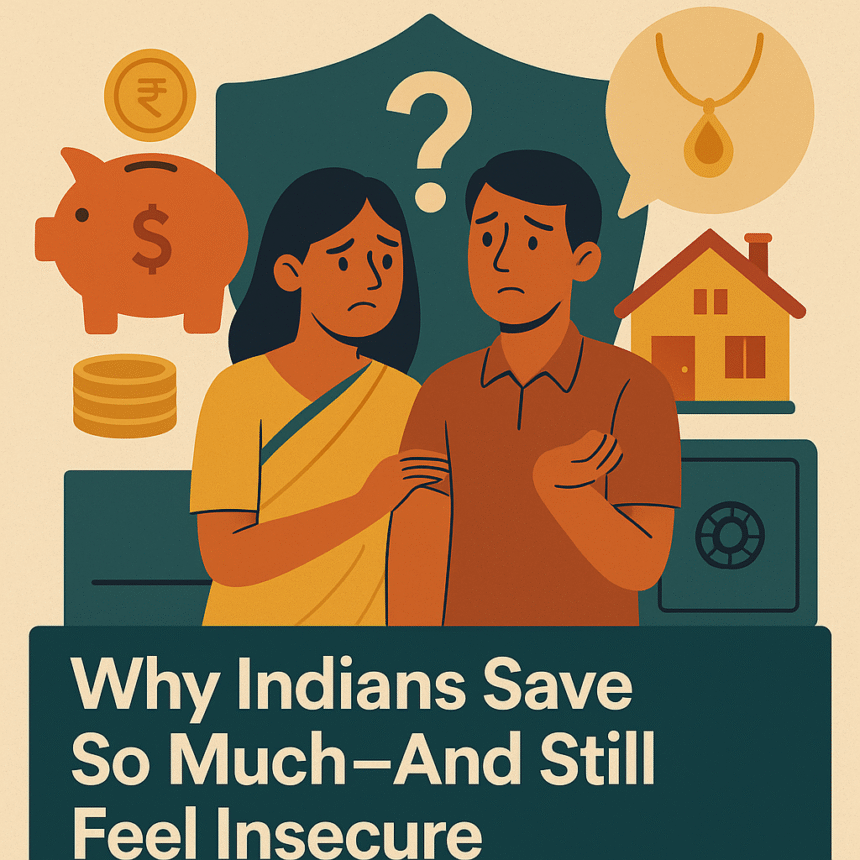
In every Indian household, money has always been more than just numbers. It’s been about safety, respect, responsibility—and above all, control. From childhood, we’re taught to save. Not just encouraged—conditioned.
“Don’t waste money.”
“Save for the future.”
“Buy land, buy gold. That’s real wealth.”
And we listened. We became a nation of savers. We built fixed deposits, collected gold over generations, and bought real estate whenever we could.
Yet, despite this culture of saving—we still worry.
We feel unsure.
We wonder, “Will this be enough?”
Even people with crores in their portfolio often whisper the same doubts.
So why is that? How can we save so much… and still not feel secure?
The Saving Habit: Where It All Began
It’s important to understand where this mindset comes from. Our parents and grandparents grew up in a very different India. No credit cards, no health insurance, no safety nets. If something went wrong, you didn’t have any support system to lean on—you had your savings.
So they saved. And that habit protected them.
They passed that habit on to us. And we embraced it—but the world around us changed. The economy grew. Opportunities widened. But our approach to money didn’t fully evolve with it.
The Gap Between Saving and Planning
Saving, by itself, is not wrong. In fact, it’s essential.
But saving without a strategy is just money sitting still.
We still love FDs that barely beat inflation.
We keep gold locked in lockers, untouched for years.
We invest emotionally in property—often without clarity on returns or purpose.
And we buy insurance policies that try to mix too many things, without offering real protection.
We’re doing a lot… but not always with intention.
Which is why we might look wealthy on paper—but not feel it in our hearts.
The Illusion of Control
Part of the insecurity comes from wanting to “see” our money.
Cash in the account. Land in our name. Gold in our locker. It gives us comfort.
But that comfort is often misleading. Money sitting idle is slowly losing value to inflation. And when we don’t understand how our money is working (or not working), that nagging feeling of uncertainty stays with us.
We may be saving—but we’re not moving forward.
It’s Not Just Logic. It’s Fear.
And then there’s the emotional side. For most Indian families, money is tied to identity. It’s our buffer against the world. We’ve seen relatives fall into debt. We’ve witnessed how one illness can wipe out savings. We’ve seen jobs vanish, markets crash, plans change overnight.
So even when we have “enough,” we don’t really believe it.
We hold back. We over-prepare. We tell ourselves:
“What if something goes wrong?”
“What if I need this later?”
“What if my kids struggle?”
This fear is real. And when it’s unaddressed, it becomes a quiet, constant anxiety—one that even a big bank balance can’t fix.
So, What’s the Answer?
The solution isn’t to save less.
It’s to save with direction.
Start with a basic financial plan—something that aligns with your life, your needs, your values. Build the right protection—term insurance, health cover, emergency fund. Begin investing—not just saving—so your money grows with you. And most importantly, understand your own definition of “enough.”
Because that’s the truth most people miss: Security isn’t about how much you have. It’s about how clearly you understand it.
Let’s Evolve the Mindset
Our elders taught us well. Their caution gave us a foundation. But now, it’s on us to take that wisdom and pair it with clarity.
Let’s not just save. Let’s save with a goal.
Let’s not just accumulate. Let’s align.
Let’s not just pass on wealth. Let’s pass on awareness.
Because peace of mind doesn’t come from numbers alone.
It comes from knowing your money is not just safe—but serving your life.
Aakarsh Dalmia
Certified Financial Planner CFPCM