Why Investors Stop SIPs at Exactly the Wrong Time
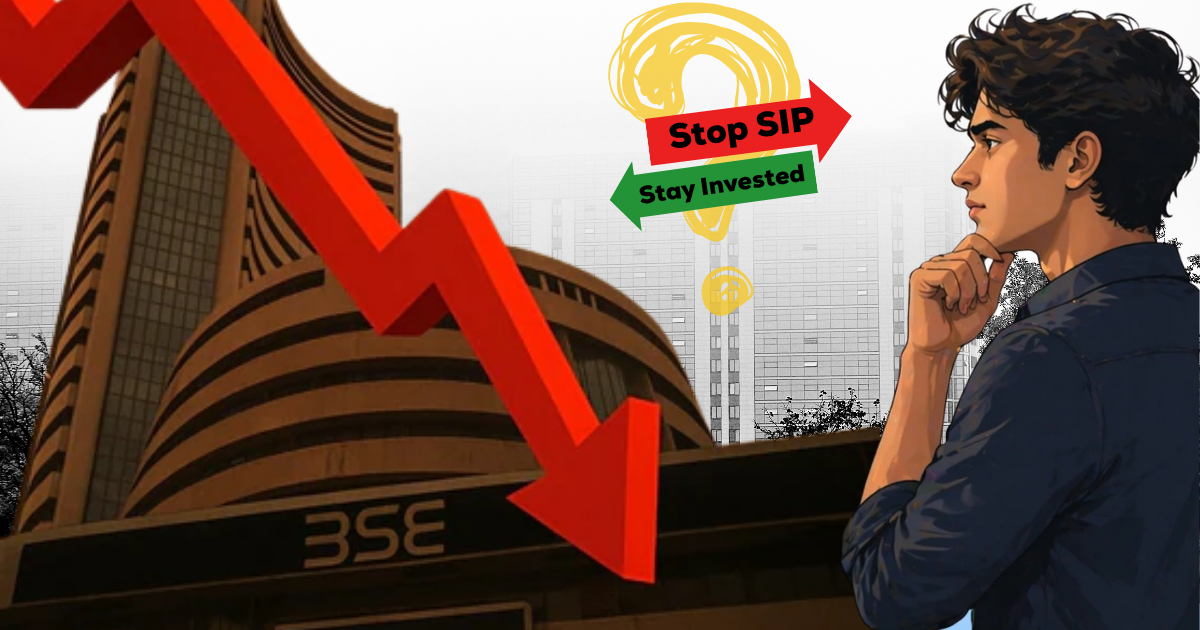
Most investors do not stop their SIPs when things are going well. They stop when markets fall, returns look disappointing, or uncertainty starts to feel uncomfortable. And that is exactly where the problem begins.
A SIP is meant to help you invest through different market cycles. Yet the moment the difficult part of the cycle arrives, many investors start wondering whether the SIP is working at all. Recent AMFI data shows that SIP participation in India remains very large, even as discontinuations continue to be meaningful. The issue, therefore, is not whether investors have heard of SIPs. It is whether they really understand what a SIP is supposed to do when markets are not behaving the way they want.
One of the biggest mistakes investors make is expecting a SIP to produce a smooth, steadily rising return. You invest every month, complete a year, open the portfolio, and naturally expect to see a good positive number. But markets do not work according to your SIP anniversary. You may invest consistently for twelve months and still find the portfolio flat. At times, you may even see a temporary negative return. That does not automatically mean the SIP has failed.
A SIP is simply a way of investing a fixed amount at regular intervals. It helps automate the process and keeps you investing across different market levels. It does not remove volatility. In fact, volatility is part of the reason systematic investing can be useful.
This is where investor behaviour becomes interesting. When markets are rising and portfolios are showing strong returns, people are usually happy to continue their SIPs. But when markets correct and returns fall sharply, the conversation changes very quickly. Suddenly the questions begin. Should I stop my SIP? Should I wait for the market to improve? Should I restart when things become more stable?
But if you stop investing every time markets fall, you may actually be giving up one of the most useful features of a SIP. When prices are lower, the same amount of money buys more units. That is the basic idea behind rupee-cost averaging. You do not know whether the market will fall another five percent, recover next week, or remain weak for six months. And that is precisely why trying to time your SIP usually defeats the purpose of having one.
Another mistake investors make is judging a long-term investment using very short-term performance. Someone starts an equity SIP for retirement fifteen years away. Eighteen months later, markets have been weak and the portfolio has delivered only three or four percent. Suddenly the investor feels the investment is not working.
But what has actually changed? Has retirement moved from fifteen years away to next year? Has the goal changed? Has the investor’s ability to save changed? Or has only the current return number changed? These are very different things.
If the goal, time horizon, and asset allocation still make sense, short-term market performance should not automatically dictate your behaviour. A temporary fall in your portfolio is not the same as a permanent loss. And a disappointing one-year return tells you very little about what the next ten years may look like.
Ironically, the SIP often feels most uncomfortable when the discipline behind it matters the most. During strong bull markets, continuing a SIP is easy. Your portfolio looks good, financial news is optimistic, and everyone around you seems confident. You do not need much discipline in those periods. The real test comes when markets are falling, headlines are negative, and another asset class suddenly starts looking more attractive.
That is when the process matters. The value of a SIP is not just that money gets debited automatically from your bank account. Its bigger value is that it removes the need to make a fresh emotional decision every month.
That said, this does not mean a SIP should never be stopped. There are many valid reasons to stop or change one. Your financial goal may have changed. Your cash flow may have reduced. Your emergency fund may need attention. Your asset allocation may have become too equity-heavy. A particular fund may no longer fit your portfolio. You may also be getting closer to your goal and need to reduce risk gradually.
Those are financial planning decisions.
Stopping a SIP simply because markets have fallen is a market-timing decision. And the two should not be confused.
Instead of asking, “My SIP is giving poor returns, should I stop?”, ask better questions. Has my goal changed? Has my time horizon changed? Has my risk profile changed? Is my asset allocation still suitable? Is the fund still doing the job it was selected to do?
If the answers remain the same, then a temporary market correction on its own may not be a good enough reason to stop investing.
If you are investing for something ten or fifteen years away, there will be many difficult periods between today and your goal. There will be elections, recessions, wars, interest-rate cycles, market crashes, bull runs, expensive valuations, cheap valuations, and events no one can predict today.
If your investment strategy depends on correctly deciding when to stop and when to restart every time something happens, you have made the process unnecessarily difficult.
The purpose of a SIP is not to predict all of these events. It is to help you keep investing despite them.
Most people believe successful investing is about knowing what the market will do next. I think successful investing is often much simpler than that. You do not need to predict every market move correctly. But you do need to avoid abandoning your process every time the market makes you uncomfortable.
The investors who eventually benefit from compounding are not always the ones who found the perfect entry point. Very often, they are simply the ones who stayed invested long enough.
So the next time markets fall and you feel tempted to stop your SIP, do not immediately ask whether the market will recover. Ask yourself a more useful question.
Why did I start this SIP in the first place?
If that reason still exists, your long-term plan probably deserves more importance than today’s market mood.
Because the worst time to abandon a long-term investment plan may be exactly when following it feels the hardest.
Mutual fund investments are subject to market risks. Read all scheme-related documents carefully. This article is for investor education and should not be considered a recommendation to invest in any particular mutual fund scheme.
Aakarsh Dalmia
Certified Financial PlannerCFP
Instagram id – wealthwithaakarsh