Can India’s Yoga Heritage Help Solve a Modern Movement Crisis Through Biomechanics-Based Medical Yoga?
Human beings are moving less than ever before while expecting the body to behave as if nothing has changed.
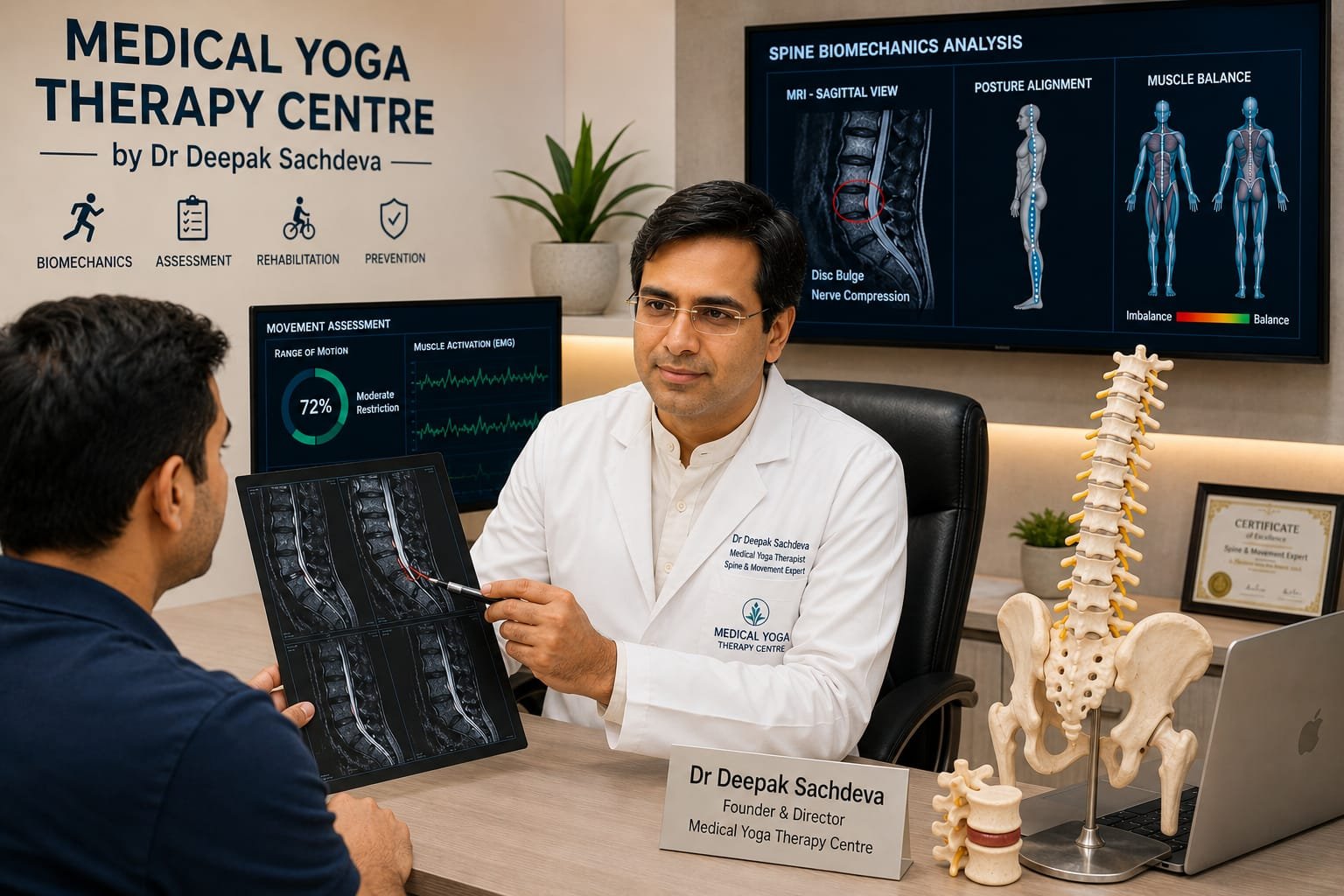
Inside a newly developed Human Body Biomechanics Lab in Delhi, therapists are studying something most people rarely think about until pain begins — the way modern life is mechanically reshaping the human body.
How people sit. How they walk. Why spinal discs begin losing hydration. Which muscles weaken first during prolonged sitting. Why certain nerves come under pressure. Why one exercise helps one individual but worsens another.
The questions may sound technical, but the problem is becoming increasingly visible across urban India.
A 17-year-old student arrives with neck pain severe enough to affect his studies. A startup founder struggles to sit through meetings because of sciatica. A gym enthusiast develops worsening leg pain after following online workout videos. A senior executive carries MRI reports from multiple specialists and has already been advised surgery.
Different ages. Different professions. Different lifestyles.
Yet many of them arrive with the same underlying problem: a body struggling to adapt to modern movement habits.
The trend is not unique to India. According to the World Health Organization, low back pain is now the leading cause of disability worldwide, affecting an estimated 619 million people globally. That number is projected to rise to 843 million by 2050.
According to rehabilitation specialists, the human spine was not designed for prolonged sitting schedules, screen-heavy lifestyles, weak stabilizing muscles, repetitive postural stress, and poor movement habits. Yet modern routines are increasingly built around stillness, and the rise of AI-driven work may accelerate this trend further.
People sit to work. Sit to travel. Sit to relax. Even leisure has become screen-based. Over time, spinal discs lose hydration, posture deteriorates, supportive muscles weaken, mobility reduces, and pressure on joints and nerves gradually increases.
What makes the situation even more concerning is that many people unknowingly worsen these conditions through incorrect exercise choices. Random online workouts, aggressive gym routines, and generalized group exercise programs are often performed without understanding spinal condition, nerve involvement, movement limitations, or muscular imbalance.
In many cases, the wrong exercise at the wrong stage may aggravate compression, instability, and pain rather than improve recovery.
This growing challenge is contributing to a broader healthcare conversation around movement science and preventive rehabilitation. Beyond individual suffering, movement-related disorders contribute to lost productivity, absenteeism, reduced workforce participation, rising healthcare expenditure, and declining quality of life. As sedentary lifestyles become more common, many experts believe this burden will continue to grow.
The biomechanics lab forms part of an emerging initiative under the Medical Yoga Therapy Centre founded by Dr. Deepak Sachdeva, PhD. The objective is to better understand how modern movement dysfunction develops and to identify which therapeutic movements, ergonomic corrections, spinal mechanics, and rehabilitation strategies can help individuals recover function while reducing long-term disability, unnecessary surgical burden, and prolonged dependence on pain medication.
Many of the individuals seeking help have been diagnosed with slip disc, sciatica, cervical spondylosis, lumbar spondylosis, nerve compression, or chronic back and neck pain. The focus is on understanding the mechanical cause of the problem and using biomechanics-guided rehabilitation, therapeutic movement, ergonomics, and medical yoga to help suitable patients recover without surgery wherever medically possible.
The lab is also being used to study movement patterns, spinal loading, muscular imbalances, gait behavior, and functional limitations with the aim of developing more individualized rehabilitation strategies rather than relying on one-size-fits-all exercise prescriptions. The broader goal is to better understand why some people recover quickly, why others deteriorate despite treatment, and how movement-related disability can potentially be reduced before it progresses toward chronic dysfunction or surgical intervention.
The larger philosophy behind the initiative is that most chronic musculoskeletal disorders do not appear suddenly. They accumulate silently through years of repetitive mechanical stress. This also highlights the importance of preventive care. Once rehabilitation is complete, preventive movement practices must begin immediately to help reduce recurrence and preserve long-term function.
Many healthcare observers believe this is where India’s movement-based health traditions — including yoga, yoga therapy, and medical yoga — may find renewed relevance when interpreted through biomechanics, rehabilitation science, and preventive healthcare frameworks rather than being viewed solely as wellness practices.
Supporters of this approach argue that the future of healthcare cannot depend solely on treating disease after it appears. It must also include preserving function, mobility, and independence before they are lost.
If modern medicine helped humanity live longer, movement science may help humanity live better.
The future of healthcare may depend not only on treating disease, but also on preserving human movement before dysfunction becomes disability.