From Escaping the Classroom to Engineering the Future: The Unconventional Journey of Daksh Sagar Gaikwad
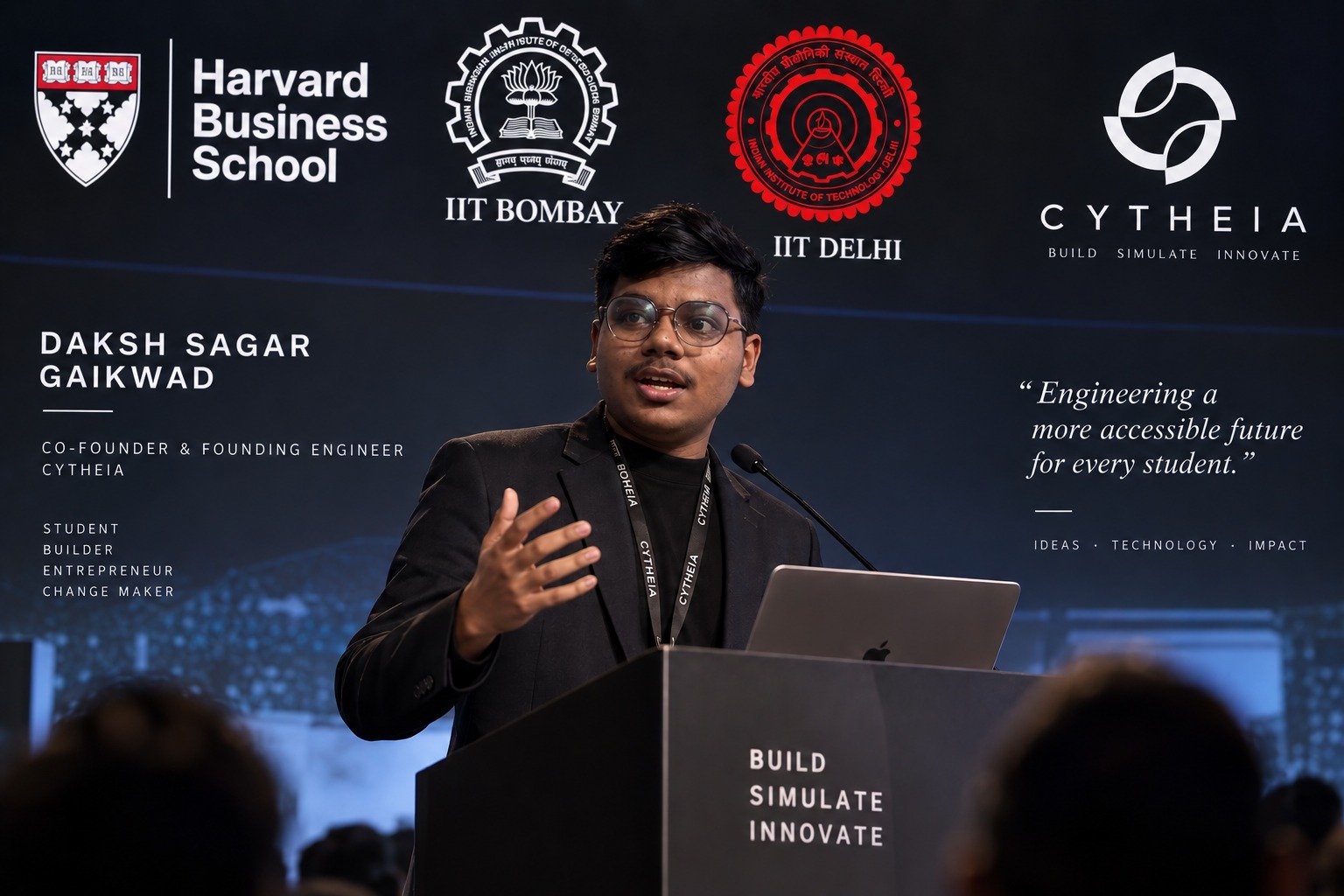
At 17, while many students are still figuring out what they want to do after school, Daksh Sagar Gaikwad is already building technology, working as a co-founder and founding engineer, competing on national platforms, representing India internationally, and developing products designed to make engineering more accessible to students.
His story, however, did not begin with a startup.
It began with a desire to escape the classroom.
The Classroom Wasn’t Working.
So He Built His Own Path During eighth standard, Daksh found himself increasingly disconnected from conventional classroom learning. He wasn’t interested in sitting through lessons simply because he was expected to. His academic performance reflected that lack of interest, and criticism became familiar.
Instead of spending another period inside the classroom, he began going to his school’s Atal Tinkering Lab.
At first, the lab was simply an escape from a classroom he didn’t enjoy. But once he was there, something changed.
He started experimenting.
He learned electronics manually, searched the internet whenever he didn’t understand something, watched tutorials, read documentation, tested ideas, broke things, rebuilt them and kept going. There was no conventional curriculum telling him what to learn next. He simply followed his curiosity.
That curiosity eventually became a skill set.
From Experimenting to Building
By ninth standard, Daksh had moved from experimenting with technology to building actual projects.
One of his projects was a Pothole Detector, an engineering concept focused on identifying potholes and addressing a real infrastructure problem. The project received recognition through major student innovation platforms, including selections associated with institutions such as IIT Bombay and IIT Delhi, according to Daksh’s account.
The experience changed his understanding of what was possible.
He realized that a student didn’t have to wait until college to build something meaningful.
So he kept building.
During tenth standard, Daksh began traveling to different institutions and competitions to demonstrate his projects, participate in innovation events and compete against other young builders. The classroom was still there, but increasingly, his real education was happening outside it.
When Marks Didn’t Tell the Whole Story
Daksh’s academic journey does not follow the conventional definition of a high-achieving student. He has openly spoken about receiving low marks and being criticized for them.
But he found another way to measure progress.
Could he build something? Could he make it work? Could he explain it? Could he put it in front of judges? Could he improve it after it failed?
Those questions mattered more to him than a marksheet.
His journey became less about proving that he could score and more about proving that he could create.
From Student Builder to Young Founder That builder mentality eventually evolved into entrepreneurship.
Daksh became the co-founder and founding engineer of CYTHEIA, a technology platform focused on AI-powered electronics design, simulation and engineering. The idea behind CYTHEIA is to make sophisticated engineering workflows easier for students and young builders to access.
Instead of forcing students to navigate complex engineering software without guidance, CYTHEIA aims to provide an environment where they can design, experiment, learn and build.
The platform focuses particularly on students working on electronics and engineering projects, giving them access to tools and guidance that would traditionally require significantly more technical experience. According to the team, CYTHEIA attracted more than 1,000 users within its first month, alongside growing engagement across its social-media presence and student community.
For Daksh, CYTHEIA is more than another startup. It is an extension of the environment that helped him learn in the first place. He once had to search for answers, experiment with hardware and teach himself how things worked. Now, he wants the next generation of students to have a more accessible path into engineering.
From India to the International Stage
Daksh’s interests have expanded beyond electronics. Artificial intelligence has become another major part of his work, with significant time spent studying generative AI, prompt engineering, AI-assisted development and emerging AI tools.
Rather than treating AI as something to study only academically, he approaches it as a practical engineering tool. His focus is not simply understanding what AI can do, but understanding what can be built with it.
In 2026, that journey took him beyond India’s student innovation ecosystem. Daksh participated in the Harvard Youth Summit, representing India and traveling independently to Malaysia for the international program.
For someone who had once been criticized for his classroom performance, standing internationally as a young Indian entrepreneur and technology builder represented a very different kind of achievement. According to Daksh, he secured top positions across the summit’s assessment components and received recognition during the program.
Building What Comes Next
His experiences have also taught him that entrepreneurship extends far beyond building a product. A founder has to understand people, business, communication, markets, leadership and how to turn technology into something others genuinely want to use.
That shift from being a student who builds projects to someone who thinks about products and companies represents one of the biggest changes in Daksh’s journey.
The long-term ambition behind CYTHEIA reflects that evolution. Daksh and the team are working toward creating a global engineering technology brand that can serve students, makers, educators and engineers.
The philosophy is simple: engineering should not feel inaccessible simply because the software is complicated. A student should be able to have an idea, open a platform and start building.
Daksh knows what it feels like to begin without knowing everything. He knows what it means to search for answers one problem at a time and to have an idea before having the technical knowledge to execute it. That experience now shapes what he is trying to build for others.
There is an easy way to describe Daksh: a 17-year-old entrepreneur, co-founder, founding engineer, AI and electronics builder, international youth summit participant and technology founder.
But those titles miss the most important part.
He was once a student who was bored in class and went looking for somewhere else to learn. He found an ATL lab. Then he found Google, electronics, engineering, AI, competitions and eventually entrepreneurship.
That progression says more than any title.
At 17, Daksh Sagar Gaikwad is still at the beginning. But the direction is clear.
He isn’t waiting for permission to become an engineer. He isn’t waiting for a degree to become a founder.
He is building the future himself.