INDUSTRY THOUGHT LEADERSHIP
Krishna Marathe on Choosing Plastic Pallets for Warehouse Automation Before the Racking Is Fixed
KRISHNA MARATHE
Founder, Swift Technoplast Private Limited
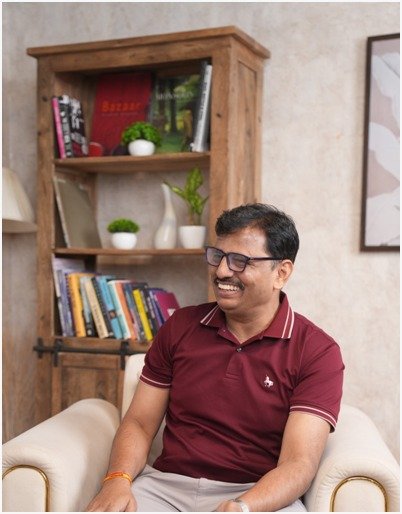
Krishna Marathe, Founder of Swift Technoplast Private Limited
When a company plans a new plant or warehouse in India, the pallet is usually one of the last items on the purchase list. The racking is drawn, the automated storage and retrieval system is specified, the forklifts are ordered, and only then does someone ask for three quotes on pallets. Krishna Marathe, Founder of Swift Technoplast Private Limited, a Navi Mumbai manufacturer of plastic pallets and material handling products, believes that sequence is behind many pallet failures. Plastic pallets for warehouse automation, he argues, need to be designed into the project, not bought after it.
An engineer’s view of a commodity purchase
Krishna Marathe has spent more than two decades in design, production and sales. Before starting his own company in 2008, he worked across those functions at Godrej & Boyce, an experience that shaped how he looks at a pallet: as an engineered component of a larger system rather than a catalogue item. He also serves as a Special Invitee Member of the Bureau of Indian Standards TED 24 committee, the sectional committee responsible for transport packaging and pallet standards.
That mix of factory floor and standards work shows in how his team begins a project. Before any price is discussed, they ask where the pallet will actually live: the temperature it will face, the rack level it will sit on, the load it carries, how it will be lifted and who will walk on it. For Marathe, a buyer who cannot yet answer those questions is not ready to choose a pallet.
Why automated warehouses raise the stakes
Warehouse automation in India is maturing. A May 2026 analysis by Spherical Insights describes adoption moving from early trials into a more structured phase, with decisions shaped by return on investment and application fit rather than technology hype. That shift matters for the humble pallet.
In a manually run godown, a slightly warped or undersized pallet is an inconvenience. In an ASRS or a high-bay racking system, it can stop a shuttle, trigger a retrieval error or drop material from height. Tolerances are tighter, loads stay in place longer, and the pallet becomes part of the machine’s interface. Rackable plastic pallets have to carry their load across the beam span for months, and do so at the facility’s real operating temperature, including cold rooms where a poorly specified pallet can crack.
The standards environment has moved too. In 2024 the Bureau of Indian Standards, through the TED 24 committee, adopted a revised Indian standard on test methods for flat pallets, identical to ISO 8611-1:2021. For buyers, that offers a recognised way to ask for evidence instead of relying on a single load figure printed on a spec sheet.
Krishna Marathe’s view is that most pallet problems are not material problems. They are decisions made too late, after the racking and automation were frozen and the pallet had to be forced to fit.
How Swift Technoplast approaches a new facility
Swift Technoplast manufactures plastic pallets, spill containment systems and material handling solutions, with more than 600 pallet variants across over 200 designs. For larger projects, the company runs what it calls Pallet Journey Mapping, a study of every touch point a pallet passes through, from rack to truck to return. The output is a recommendation, complete drawings and load analysis, followed by a sample trial inside the client’s own operation before any order is placed. Test reports are issued against Indian standards, giving plant heads and QA teams documentation they can review.
The approach has a long-running reference point. For one pharmaceutical client, the company supplied 6,700 returnable plastic pallets that have now been in service for 12 years, with 55 reported damaged over that period. Today the business exports to more than 40 countries and employs a team of over 225 people.
The pallet as a ten-year decision
Krishna Marathe’s practical advice to anyone planning a new facility is direct: bring the pallet supplier into the room while the racking and automation are still on paper. A pallet chosen at that stage can be sized, tested and documented for the system it will serve. One chosen afterwards becomes a compromise the operation lives with for a decade.
As Indian companies invest more in warehouse automation, the ones that get the most from it may be those that treat the smallest component with the same seriousness as the largest. That is the case Krishna Marathe has been making, one facility at a time.