


In the high-pressure corridors of India’s sales landscape, a quiet crisis is unfolding.
Thousands of high-performing professionals in EdTech, real estate, insurance, and banking find themselves trapped. They are the engines of the economy, yet they work in a cycle that feels designed to exhaust them. Six-day work weeks are the norm; seven-day weeks are common. They chase targets that shift like desert sands, often in environments where the “churn and burn” culture is the only strategy.
Despite their grit, most of these professionals find their earnings plateauing under ₹8 LPA. They have the talent, the hunger, and the “hustle.” What they lack is a bridge to the promised land: B2B SaaS.
Software as a Service (SaaS) is the crown jewel of the modern economy. It offers a world of five-day work weeks, structured growth, global exposure, and a financial trajectory where ₹30–40 LPA is a realistic milestone within five years.
The gap between these two worlds, however, is wider than it looks. This is the gap that Amit Semwal is currently closing.
The Architect of the Pivot
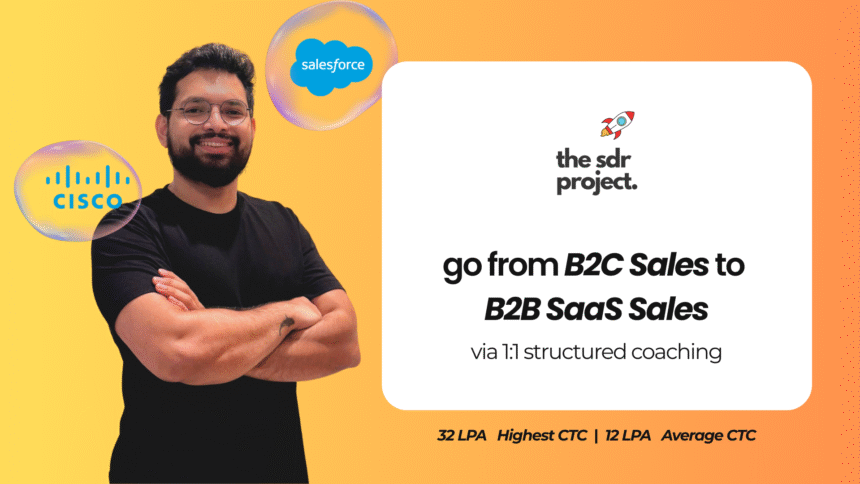
Amit Semwal, (founder of www.theSDRproject.com) is not a career theorist; he is a practitioner who cracked the code himself. Before he became a mentor, Amit navigated the arduous climb from the chaotic trenches of B2C sales into the elite circles of Enterprise SaaS.
Having worked with global giants like Salesforce and Cisco, Amit gained a perspective that few possess. He realized that the “failure” of B2C salespeople to enter the SaaS world wasn’t a lack of ability. It was a failure of translation.
“Most B2C sales professionals are incredibly skilled,” Amit observes. “They are resilient and persuasive. But they fail to transition because they don’t know how to position those skills for a B2B context. They are applying for 21st-century tech roles using 20th-century job-hunting tactics.”
This insight led to the birth of The SDR Project – a boutique transition system designed to turn B2C “hustlers” into sophisticated B2B “consultants.”
Why the “Old Way” of Job Hunting is Dead
According to Amit, the reason most applicants face a wall of silence from SaaS recruiters is rooted in five specific mistakes:
- Resume Mismatch: Using resumes that highlight high-volume B2C “calls” rather than B2B “value-building.”
- The Portal Trap: Relying on generic job boards where their applications are buried by algorithms.
- Role Confusion: A fundamental misunderstanding of what a Sales Development Representative (SDR) actually does.
- The Mock-Call Hurdle: Failing the high-stakes roleplay rounds that define SaaS interviews.
- Passive Outreach: Waiting to be discovered rather than proactively engaging with hiring managers.
Amit’s approach is to stop “shooting in the dark” and start “reverse-engineering the hiring process.”
The SDR Project: An Anti-Bootcamp Approach
In an era of mass-marketed, pre-recorded “bootcamps,” Amit has taken a radically different path. The SDR Project is a 12-week, 1:1 coaching program. It isn’t a lecture series; it’s a high-touch apprenticeship.
The framework covers every inch of the transition:
- Identity Rebuilding: Crafting ATS-optimized resumes and LinkedIn profiles that demand attention.
- The Technical Edge: Teaching TechSales fundamentals and the specific “language” of SaaS.
- The Execution: Real-world training in cold calling, objection handling, and recording mock calls until they are flawless.
- The Strategy: A bespoke roadmap for outreach and salary negotiation.
The goal isn’t just to help a candidate find a job; it’s to help them command a premium. The results speak for themselves. With over 30 successful transitions, the average starting package for Amit’s mentees sits between ₹10–12 LPA, with some achieving staggering hikes of up to 350%. The highest CTC achieved by a graduate stands at ₹32 LPA.
More Than Just a Paycheck
While the financial rewards are significant, the “brand value” of a move into B2B SaaS goes deeper. For many, it is a restoration of their professional dignity.
In B2B SaaS, the path is clear: you start as an SDR, move to Business Development roles, then to Account Executive(s), and eventually into Sales Leadership. It is an industry that rewards curiosity and strategy over raw volume.
“We are seeing a career reset,” says Amit. “Beyond the salary, our candidates are getting back their weekends. They are getting global exposure. They are entering an ecosystem where their performance is measured by the value they create, not just the hours they stay at their desks.”
Redefining the Future of Sales
As the Indian tech ecosystem matures, the demand for high-quality B2B sales talent is skyrocketing. However, the supply of “SaaS-ready” professionals remains low.
By focusing on 1:1 mentorship rather than mass-production, Amit Semwal is doing more than just coaching; he is building a high-trust pipeline for the industry. He is taking the “chaos” of traditional Indian sales and refining it into the “structure” of the global SaaS economy.
For the salesperson currently working their tenth straight day in a high-stress office, wondering if there is a better way – Amit Semwal has already built the bridge. The SDR Project isn’t just a training program; it is the definitive gateway to the next decade of sales excellence.